Thursday, 29 May 2008

Vagabond (Varda, 1985)

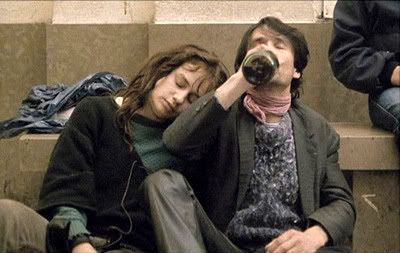
Agnès Varda's deceptively simple observations about a girl who willfully drifts on the peripheries of society are packed with resonance. Her decision to intersperse the action with "interview" footage from those that "knew" the girl (Mona) is inspired, providing the audience with a variety of perspectives that contribute to the unique prism through which we view Mona's life. These testimonies don't entirely correlate with Mona's on-screen actions, but they're fascinating examples of the ways in which human beings view one another, and they simultaneously highlight the concept of the unreliable narrator. Take Yolande for example, who romanticizes Mona and her brief fling with a fellow drifter as a portrait of idyllic love after their first 'meeting' (in reality, it's simply somewhere for Mona to sleep and smoke a joint or few), before villifying her after their second encounter when she threatens to encroach upon the sanctity of both Yolande's job and her relationship. On both occasions, Yolande's own concerns take precedent over any attempt to understand Mona's situation, thus begging the question: just how much do we really know and understand about brief acquaintances such as this? By having the viewer witness Mona's final days as she herself pieces them together, Varda manages to illuminate the film with some lofty themes: the transience of life; and perhaps more importantly, the difficulty of truly comprehending it.

Varda's unassuming direction allows the viewer to remain neglectful of the fact that Mona/Varda's journey is one that traverses the breadth of (then-)contemporary French society until late into the film - by which point the director's critique re: the inability of Mona's former companions to prevent her fate has considerably sharpened. The final act, rife with a series of coincidences and a downright bizarre paint fight of sorts, alludes to a society in chaos (although the strength of such allegory is debatable). "Society" is a potent presence throughout this piece: Mona's predicament (presumably) occurs through her continual defiance of that which is socially acceptable. Mona even disregards an opportunity provided by reformed hippies who sympathize with her plight and offer her a chance to succeed on the peripheries of the "system"; and one of the most humorous yet telling encounters finds a prostitute asking her to leave her turf because she's "bad for business". Varda deftly reveals how materialism is a fundamental part of life, and by relinquishing the former Mona effectively sabotages the latter.

No one is willing to help Mona on her own terms, but Mona isn't necessarily looking for help. Varda's matter-of-fact presentation never explicitly asks any questions of either viewer or character. This stark but sincere depiction of life outside accepted norms lacks the venom to function as a diatribe against French society as a whole. Furthermore, Mona's rebellion is one that Varda refrains from romanticizing or moralizing (as some of the film's ancedotes do). The director's refusal to provide any real background for this character combines with her documentarian approach to reinforce the integrity of what's on-screen. Mona exists, Mona expires, and there's little more to it. Vagabond's ability to so directly expose this tenuous hold on one's existence is the source of its genius.

Tuesday, 27 May 2008

Limelight (Chaplin, 1952)

A portrait of the artist as an old man, then. And what a melancholy mess of a portrait this is! A self-reflexive, shamelessly narcissistic meditation on the increasing irrelevance of the fading star, this might well be the most complex and intelligent film of Chaplin's career. (As a sidenote, the fact that I watched this straight after The Gold Rush meant that I inadvertently found myself with a fascinating double-bill on my hand, esp. when one considers that it's the simplicity of the earlier film and the "Tramp" that I admire so much.) Watching arguably the greatest movie star that ever lived pour so much of himself into this project makes for a viewing experience that's as uncomfortable as it is compelling. Limelight marks the filmmaker's poignant attempt to exorcise his personal demons once and for all - and for a figure as gargantuan as Chaplin to willingly deface the mythology of his cherished past is an act of bravery that commands nothing but awe from this viewer.

The film unfolds in the tradition of grand, if somewhat bizarre, melodrama - perhaps the genre best able to accommodate the insecurities of a star such as this. Moreover, Chaplin's refusal to leave the ghost of the past behind contributes to a sense of unease regarding the film. The spectre of the Tramp manifests itself throughout: in Calvero's costumes; in his description as a "tramp" comedian; in a dream sequence where Calvero pours salt on a rose and proceeds to eat it (harking back to a similar scene in The Gold Rush); and in every one of his Charlot-esque mannerisms that only heighten the sense of awkwardness which characterizes the film. At one point, Calvero goes so far as to declare that: "There's something about working the streets that I like. It's the tramp in me, I suppose." Chaplin's nonchalant delivery belies the significance of a statement that so tellingly alludes to both the performer's vaudeville past as well as his most famous creation. And this is merely one of many instances where the text mines the depths of its author's career to deepen its own perspective - the entire film is transfused with an acute awareness of history and the artist's place within it. To this end, one finds Calvero frequently framed against self-portraits in the interior spaces of his home. Although the framing alternates between subtle and unavoidable, each composition carefully augments the inescapable hold of stardom within Chaplin's intricate narrative.

Notably for a Chaplin film, Limelight is almost shockingly devoid of humour. Whereas the director's previous features had attempted to negotiate an equilibrium between comedy and pathos, Limelight extinguishes the bright flame of the former altogether and thus allows the latter to overwhelm the film's thematics. Calvero's jokes and wisecracks simply aren't worthy of our laughter, and his comedy routines make for painful viewing. Compare, for example, the "flea sequence" with anything made prior to 1940 and the discrepancy becomes grossly apparent. It's when in his supposed element that Calvero becomes most devastatingly exposed as an outdated relic. As he attempts to bury his shame under: first, a false name; and then, one last showcase; one senses Chaplin simultaneously attempting to bury his own past in the character of Calvero, with Limelight's canvas itself functioning as the platform for the final triumph.

With this in mind, perhaps the most moving facet of the film is to be found in its examination of the relationship between star and audience. The blatant artificiality of the film's sets and the prominence given to the stage/audience delineation during the film's final third contribute to this fundamental dilemma regarding the construction of stars. However, its within the core Calvero/Terry relationship where these questions find their most pertinent voice. The aforementioned "Tramp-isms" that Chaplin brings to this role are coupled with a taste for excess when it comes to line delivery during their scenes together, thus elevating him to the level of "performer" with the bed-ridden Terry as the effective replacement for his lost "audience". At one stage, after an impassioned monologue about the beauty of life, Calvero concludes by exclaiming "Goodnight!", as if to further emphasise this mutually beneficial role-playing. It's in the comfort of the theatrical world where one receives glimpses of the real Calvero: after the revelation of an empty theatre during a dream sequence, the camera cuts to a close-up of Chaplin's devastated face. Few stars managed to film so successfully and consistently in close-up as Chaplin, and the indelible image of the heartbroken yet resilient Tramp that's recalled by this shot is difficult to dispel.

Limelight is the most structurally incoherent of Chaplin's major features (that I've seen, at least), and I imagine that the occasionally-clunky editing and bizarre tonal shifts do little to help its cause in the eyes of the general public. (And that's saying nothing of Claire Bloom's marmite work!) But this is a film that appears on-screen as a confessional outpouring of the soul. Surely then, it's cluttered narrative and confusing emotional landscapes are somewhat appropriate? It's easy to accuse Chaplin of self-indulgence here, and the decidedly underwhelming showdown with fellow silent-era giant Buster Keaton provides fuel for the fire. Nevertheless, this seems to bypass the purpose of their much-anticipated sequence together, which is designed first as a self-critique of Calvero/Chaplin's own egotism and second as a touching reminder of all that's been lost due to the cruelty of time. As Calvero himself poignantly defers: "Time is the great author. It always writes the perfect ending." Limelight is one of the saddest demonstrations of this ideal that I can imagine. But Calvero does indeed find peace at film's end, and Limelight itself benefits from that phenomenal conclusion. One can only hope that Chaplin too, managed to get rid of his own demons once and for all. Lord knows he deserves it for providing us with a Hollywood swansong as beautiful as this.

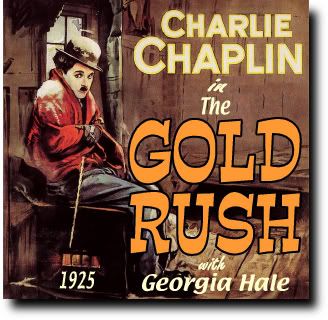
The Gold Rush (Chaplin, 1925)

Objectively speaking, 1925's The Gold Rush is - in spite of all the acclaim - a surprisingly flawed effort from Chaplin, imo. In terms of its plot, it seems considerably less refined than his later comedic efforts. Much of that fault lies with the issue of character development - what's the real purpose of Black Larsen, for example? Or why waste precious momentum by focusing on the Georgia/Jack relationship? The dynamics of that union, complete with the former's carefree persona significantly detracts from the already distractingly-contrived [Spoiler]happy ending. Is this ho-that-appears-from-nowhere really meant to be worthy of our beloved Tramp?[/Spoiler]

And yet, to focus on these elements strikes me as somewhat reductive, for all the plot gripes in the world pale into insignificance when one is dealing with what could well be the funniest of all Chaplin comedies. And that's as lofty as praise gets. For a film that's defined by its boundless energy, it seems thoroughly appropriate for the director to play fast and loose with staple narrative tools. This decision works a treat, because his alternative is to create a series of increasingly outrageous setpieces that launch a full-scale tickling assault upon the funnybone. The film brims with these bravura sequences that underline its star's gift for slapstick: the first appearance of the bear (this was the point where I fell in love with Chaplin all over again); the boiled shoe; the fights against the storm; the dog at the dance; the initial brawl between Big Jim and Black Larsen; the cabin on the cliffside; and my personal favourite, Charlie in a chicken suit. Whilst the art of film comedy probably reached its peak with the sophisticated screwballs of the 1930s/1940s, the simplistic splendour of Chaplin's own endeavours serves as a pervading reminder that complexity doesn't necessarily equate to superiority.

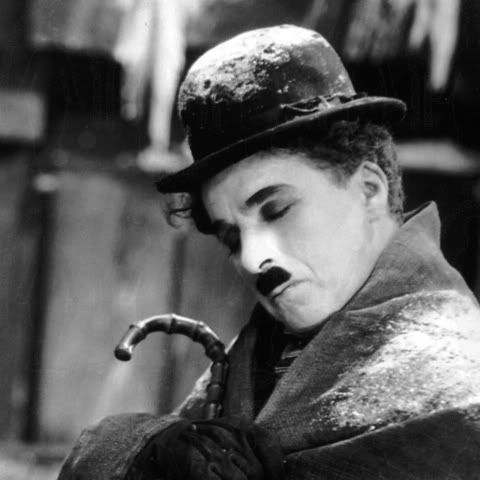
Personally, I find that the resonance of Chaplin's art consistently derives from his ability to locate light in the bleakest of situations. Although the potential for social commentary in this particular film is mostly disregarded, it nonetheless boasts moments that lay to bare the director's modest (but powerful) emotional canvas. Key to all this is the creation of the Tramp himself, whom Chaplin always embodies with such irresistible charm - to the point where I often find myself taken aback by those that don't fall for him like I do (fortunately, these people seem to exist only on the Internet, which means that they need not fear my real-life wrath). He may well be my favourite character in film history, and although his position in the social hierarchy bestows him with an underdog status that ensures sympathy to a certain degree, I really believe that the Tramp genuinely the audience's affections in his on-screen adventures. Rarely has this been better expressed than during The Gold Rush's dream sequence, where Chaplin's extraordinary talent for blending comedy and pathos reaches its zenith with the famed "Oceana Roll" - typically amusing, but concurrently gut-wrenching as a result of its distance from the Tramp's present reality. Chaplin follows this with one of the most heartbreaking close-ups this side of his own conclusion to City Lights - and once again, his crestfallen face expresses more in a mere few seconds about love, dreams, social status and loneliness, than 180 minutes of spoken dialogue ever could.

I guess I see this film as a reflection of the Tramp himself. What he and it lack in intelligence, they more than make up for with their heart. Chaplin's enduring appeal throughout the years has surely been in large part due to his ability to express painfully honest emotions with a uniquely humorous filter. It's a combination that I'm a sucker for, to be honest. So to return to an earlier point, who really gives a damn about plot?! [Spoiler]If the Tramp wants the girl, then I want him to have her too![/Spoiler] In a world where life is always hanging precariously in the balance, the Tramp's resilience and his ceaseless optimism is both admirable and infectious.

There's a brief scene in this film where the Tramp finds a self-release from all his inhibitions, and bounces off his cabin walls as if all the happiness of the world has been momentarily imbued into his meagre little frame. I feel no shame in confessing that both Chaplin and The Gold Rush have the same effect upon me. For consistently reminding me of the beauty of innocence and sentimentality where so many other directors have miserably failed, I'm indebted to him. And I would never dare let my objectivity get in the way of my subjective love for this here film.

Shadows of Forgotten Ancestors (Paradjanov, 1964)

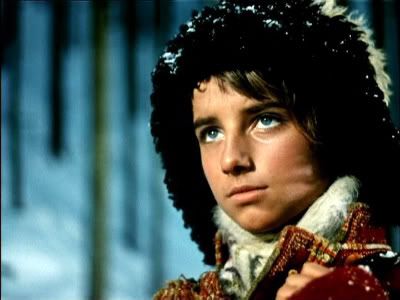
I will not dispute the status of Pomegranates as Paradjanov's most heralded film, but I will say that Shadows - as far as I'm concerned - is an even more vibrant and exciting work that dispenses with conventional film language in a manner that I find twice as scintillating as the later masterpiece. Of course, this is arguably the less complex and challenging work of art, but what does that matter when the work in question is as extraordinary as this?

Although I've only seen two of them to date, I've nonetheless arrived at the conclusion that Paradjanov's films are consistently draped in a cultural fabric that's miled removed from our own. In Pomegranates, the director overwhelms his work with symbolism that's daunts as much as it stimulates due to its privileged position in the foreground - the subtext is inextricably bound to the text itself. Shadows utilizes the same complex metaphors that characterize the later film, but here they co-exist with the narrative and enrich (as opposed to define) it. Moreover, Paradjanov grounds the film in an empathetic reality: at its core, Shadows is really a cinematic ballad about one man and his attempts to make peace with a love snatched away by the hands of fate. Armed with the dual forces of both intellectual and emotional wizardry then, Paradjanov crafts a film that's significantly more palatable than the monumental Pomegranates.

That's not to argue that Shadows is less sophisticated in its construction, however. As previously stated, Paradjanov works in a context whereby he can powerfully affirm the localized cultures of the Caucasus. Naturally then, Westernized narratives have no place in this director's filmic worlds. Shadows has an identifiable (but relatively passive) protagonist (Ivan), and reveals traces of traditional plot development, but it stops right there in terms of Western cinematic conventions. The remainder of the film exists partly in the realm of mythical folk tales, and partly as an observational ode to the customs of the Hutsuls. The film is loosely structured as a series of chapters that are inconsistent in length, and one of the most dazzling sequences finds an entire one of these chronicled through the everyday gossip of people who are completely unrelated to the dominant plot strand. This is what I mean when I claim that Paradjanov cares not for our conceptions of narrative exposition! And during the course of some 90-odd minutes, he still manages to find time to interpolate proceedings with a Biblical thread (Pieta; shepherds + sacrificial lambs; the church at the community's centre), whilst implying that the [Spoiler]film's entire first act might've taken place in Ivan's memory,[/Spoiler] thus underlining the density of the film's emotional texture. At its most polar oppositions, Shadows is a work of both irresistible romanticism and harrowing despair. It's to Paradjanov's credit that he so successfully manages to traverse the vast gulf that exists inbetween.

This world of sentimental warfare and spiritual conflicts would make for an engaging film in its own right. When one throws in this director's potent ability to express himself visually however, hyperbolic praise becomes extraordinarily difficult to resist. If The Colour of Pomegranates was a revolutionary declaration of the static camera's potential in cinema; then Shadows of Forgotten Ancestors is a revelatory extravaganza of delirious kineticism that's perhaps even more breathtaking. Mere words fail to capture the ecstatic rhythms of the director's pulsating camerawork here, the experience is akin to a primal romp played out at a hyperspeed - Paradjanov's camera bounces off walls, waltzes around entire communities and scrutinizes its picturesque surroundings with alarming intensity. From its very outset, it proves itself as quite a literal force of nature: one of the film's very first shots assumes the viewpoint of a falling tree! Later in the film, there's a supernatural occurrence when a similar tree suddenly bursts into flames, as if the fiery depths of Hell have suddenly been unleashed upon Earth. Shadows negotiates a reconciliation of these divergent natural and supernatural impulses, and Paradjanov articulates it most astoundingly following [Spoiler]the death of Ivan's father, whose "soul" is briefly glimpsed through the image of horses in red silhouettes, gracefully departing the body.[/Spoiler] Paradjanov's visual style is an intoxicating concoction of delicious colour schemes, bizarre angles and rapturous movement that could perhaps be described as some sort of super-expressionistic brand of modernism. Except that really, the director's work stubbornly defies the reductive labelling that we're accustomed to in the West. The phrase "seeing is believing" has never been more appropriate than it is here.

In the meantime, it seems necessary for me to return to the aformentioned "emotional texture" of the film, because Shadows particularly resonates on this front. Typically, Paradjanov outlines the foundations of his prevailing concerns from the get-go. [Spoiler]The film opens with the death of Ivan's brother Alekso, who meets his end whilst saving our hero. In effect, the fate that was meant for Ivan has been transferred onto Alekso - but Ivan's destiny continues to haunt him throughout the film (even during that initial death scene, part of Ivan's trauma derives from his inability to escape from the clasp of his brother's dead hand).[/Spoiler] One of the characters describes the world of Shadows as "a land forgotten by God", and it's an apt description because savagery and death seems to be a part of everyday existence here. Ivan's forbidden romance with Marichka then, functions as a tantalizing glimpse of optimism in a pessimistic world. Their scenes together are characerized by an innocence and a joviality that evaporates following [Spoiler]Marichka's death[/Spoiler]; Paradjanov's camera excitedly encircles them as if an extension of their romantic longing, but concurrently embodies the pervading mystical gloom that serves only to entrap them within their fates. Nonetheless, it's Ivan's inability to extinguish that longing that the film venerates. If Pomegranates is about the redemptive power of art, then Shadows is about the transcendent power of love. And really, who can resist such an idea when it's as compellingly rendered as it is here? The final song shared by Ivan and Marichka might well be one of the most gorgeous moments I've ever come across in cinema. Paradjanov's peculiar brand of humanism resonates so strongly with this image of two lovers-that-never-were, lost in the impeccable beauty of their own memories (lest we forget that there's also a celebration of Hutsul culture here thanks to the music involved). Although the film's final shot, [Spoiler]with a manic camera dancing alongside the drunken guests at Ivan's funeral[/Spoiler], draws us back into the circularity of the director's vision [Spoiler](death is inevitable; the world remains indifferent)[/Spoiler], it's the strength of this romance that leaves the most indelible impression here. Paradjanov instils in his audience a sense of yearning for the love itself - and he does it with such panache that one can't help but yearn for a myth like Shadows to accompany it.
The Colour of Pomegranates (Paradjanov, 1968)

The opportunity to investigate the singular filmography of Sergei Paradjanov is not one that I'd ever turn down. Paradjanov's cinema has forever piqued my interest, and the self-generated hype that overwhelmed me with regards to his most acclaimed work - The Colour of Pomegranates - motivated my decision to blind-purchase an American box set of his feature films.

However, my initial reaction here was a little confusing for me: I admired this and could clearly see that it was brilliant, but I didn't feel like I'd engaged with the text at all. Paradjanov's tableaux are so vivid and exciting, and they possess such rich symbolism that's so heavily steeped in Armenian history + culture that it makes the film something of an imprenetable behemoth of breathtaking imagery - but for the ordinary Westernized viewer like myself, it's difficult to gain much more it. Or at least, that's how I felt after that first viewing.

Following the inevitable (and necessary) second viewing I saw things differently. I think my natural instinct as a film enthusiast is to decipher all these images that are put before me, as I get a kick out of participating in the whole cinematic experience, and I also like to get the most out of the films that I love. Pomegranates, saturated as it is by a culture that's quite alien to me, denies me the gratifications that I've become accustomed to as an audience member. But I feel that Paradjanov is first and foremost concerned in evoking a response on a purely visceral level here. I imagine that even a professor in 18thC Armenian symbolism would struggle, in one sitting, to fully digest the wealth of imagery with which the director confronts the viewer. And after all, Pomegranates is effectively "poetry in motion" - designed to externalize the internal life of the poet, according to the aims that are defined in the film's prologue.

Bearing that in mind, I found the film to be quite a profound experience the second time around. With Pomegranates, Paradjanov attempts to penetrate the soul of the tormented artist, and the 'character' of Sayat Nova here is really little more than an abstract concept that allows the director to channel his own insecurities and tribulations through the poet's textual presence. Thus, I think the film is permeated by a stark emotional clarity that manifests itself most notably in the numerous intertitles, all of which seem to reveal the artist's increasing despair. A typical refrain such as "In this healthy and beautiful life, my share has been nothing but suffering" suddenly becomes infused with much greater depth of meaning when one realizes this. Pomegranates is essentially a filmic embodiment of that very quote, no? The poetry that accompanies the artist's on-screen journey via the expository intertitles articulates the latter, more despondent part of the line. But Paradjanov achieves a remarkable balance between the despair which punctuates the film, and the visual content which enlivens the first half of the sentence. The director is very much attuned to the joys of life, and Pomegranate's vibrant imagery emphatically celebrates the beauty of this decidedly Armenian existence.

It's the co-existence of these two basic strands - happiness and sadness - that make the artist's suffering (and consequently, Paradjanov's achievement) all the more poignant. The former exposes the extent of the latter as I see it, and the fact that the artist's desperation prevails despite the creation of this sumptuous filmic environment strikes me as a pretty affirmative statement on the director's part. The reconciliation of Armenian culture and history with the soul of the artist is denied (until he achieves a debatable transcendence at film's end, at least), and I sense the presence of external forces in this refusal? There's a potential critique of the Soviet regime, but I'm unsure as to whether I could come up with any particular examples off the top of my head... perhaps the return to the image of the 'bleeding' pomegranates, that are apparently symbolic of fertility in Armenia? (Thank you, Wikipedia!) Although, as we've established, the content of the film is an act of defiance in itself. Moreover, I think Paradjanov astutely notes the transience of the cultural mores that he so relishes. By working with the past, he highlights the discrepancy with the present. The distinct religious/biblical imagery and the parallels that the director creates between Sayat Nova and Christ mark a concerted attempt to elevate these traditions into the realm of the timeless through the medium of film.

And that brings me onto the last issue that I wanted to discuss, which is basically the specific role of art in Paradjanov's world. I think I've already implied that Pomegranates is markedly different from anything else that I've ever seen... but how so! The director's unnervingly static camera is compensated by the visual opulence within the frame. And the 'characters' that inhabit it are almost confrontational in the way that they frequently stare directly at the audience (which distorts the privilege of our cinematic gaze somewhat). Furthermore, there's his use of sound which threatens to render the diegetic as non-diegetic?! Either way, the film strips away the cinematic language that we draw comfort from, and remoulds the essence of the medium (the visual image) into something that's at once both archaic (the use of tableaux + Christian tapestry) and thoroughly modern (had this been done before, in this style?).

There's a glorious moment in the film where a number of saz seem to be floating in mid-air, as if they've surpassed the limitations of reality and have attained the status of metaphysical objects. The saz of course, is the instrument of the kerib, and in Pomegranates this equates to the artist. The transcendence of these guitars then, is a beautiful encapsulation of the redeeming qualities of art. And that is probably the message that most resonates with me here. Sayat Nova the man may no longer be with us, but Sayat Nova the artist is immortal. The Colour of Pomegranates, imo, proves that the same is true of Sergei Paradjanov.

Lola (Fassbinder, 1981)


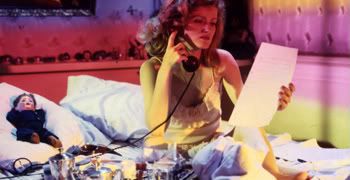
Lola (1981) maintains Fassbinder's tendency to play with our notions of genre, but this time the director underscores his work with a platform provided by the 1950s melodrama. Fassbinder's exaggeration Sirkian colour schemes borders on the grotesque, creating another image of over-perfection that paradoxically induces nothing but disgust from the viewer. And of course, the implications of Fassbinder's visual designs convey themselves within the text. Sirk is noted for probing a distinctly American psyche, and through the importation of this brand of Americana into a German environment, Fassbinder arguably makes a broader comment regarding his skepticism towards the influence of the US economy during this period (consider: the grossly fetishized results of his decision).

Lola is perhaps more directly concerned with the cost and effects of materialism than the others in the trilogy. The presence of commodities such as TVs and radios permeate the film, and the construction of a new building (later noted by Fassbinder as symbolic of the future, both due to its existence and the forces that created it) is central to the plot. Lola herself is one of these very "commodities" (has any other woman in Fassbinder's oeuvre been so willfully objectified?), and one that's desperate to become socially-acceptable - to the point where she denigrates the institution of marriage to mere deal-breaking. And yet, in a departure from Maria Braun, this film is more focused on the trajectory of a male character: von Bohm. Both he and Schukert represent the strongest male characters in the BRD trilogy, and together with Esslin they enact a compelling battle between morality and greed. No prizes for guessing which one prevails.

I initially spent quite a bit of time debating whether to watch Veronika Voss or Lola first. Watching this would've made chronological sense in terms of what the audiences of the 1980s experienced, but Veronika Voss is apparently "BRD 2" whilst this is "BRD 3"... I eventually decided to conform to the Criterion order, and I'm now thankful that I did. The titular character is the only one of the BRD's female heroines that [Spoiler]actually survives at film's end. So, whilst both the other films heavily implied the continuity of their amorality in spite of the lead's absence, Lola offers the most pertinent scenario of them all. The moral integrity of Von Bohm and Esslin has been eroded by the small-town ruling class, leaving the characters nothing else to do but resign themselves to the imagined reality of the '50s melodrama. Von Bohm and Lola are married at the end, but Schukert ultimately retains both his power and Lola herself. Von Bohm's love has become a corrupting force in its own right, as if to suggest that there's no room for it in a society so characterized by its thirst to consolidate the economic miracle. Everyone is malleable in Fassbinder's final worldview, and the final shot which establishes a graphic match between Lola's child and an earlier scene featuring Lola herself implies more brilliantly than ever that nothing will change.[/Spoiler] C'est magnifique!

This is not to say that I consider Lola to be a flawless film, by any means - it's the weakest of the trilogy, imo. I find it's final third extremely rushed in comparison to the rest of the film, and that affects our comprehension of these moral conflicts that are being waged by its characters - they come across as trite, underdeveloped (although this is also possibly appropriate, no?) Nevertheless, the film boasts some astonishing photography and some magnificent individual scenes (Lola's cabaret act; the country church). Plus, Barbara Sukowa is truly gorgeous in the title role (one of the sexiest performances in cinema?) . Anyway, the performances from Sukowa, Armin Mueller-Stahl and Mario Adorf are uniformly great (and appropriately 'melodramatic'), and Fassbinder's attack is more scathing than ever. And that makes this delectable, pour moi. So... yay?!

In conclusion: the BRD trilogy is essential viewing.

Veronika Voss (Fassbinder, 1982)

Finally continuing with Fassbinder's acclaimed BRD trilogy. Thoughts on the first part, The Marriage of Maria Braun (1979), can be found here. Comments on Lola (1981) - the final chapter of the trilogy, but second part chronologically - will follow this post.

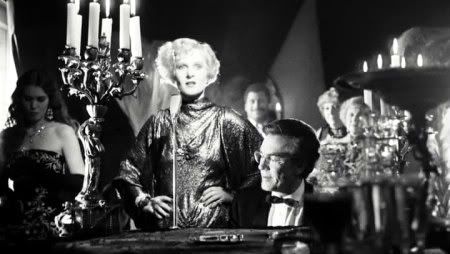
Veronika Voss is an incredibly self-conscious film that takes pains to expose its artificial nature to the audience. With every cut, Fassbinder literally seems to be underlining the relationship of Veronika to cinema itself - has any other director ever deployed such a wide variety of ways in which to edit his film? Filmed entirely in black-and-white as if to further toy with our conceptions of the 1950s noir-esque drama, Fassbinder is clearly paying homage to Wilder's Sunset Blvd. (1950) here: forgotten diva of yesterday's pictures + 'innocent' man caught up in the saga = exposé of stardom's deformed underbelly (amongst many other things). Veronika steals that basic formula and considerably widens the scope, resulting in a film that stimulates the intellect whilst slyly awakening the audience's own sense of self with its constant references to artifice and film history.

Fassbinder draws upon the pessimism of the typical noir feature here, and also takes full advantage of its potential as social critique. The role of Veronika the "star" then, plays into the BRD trilogy's trademark attacks upon the post-war German lifestyle. Under particular scorn here are the supporting characters' reactions to what she represents - namely, the 'glory' of a bygone era. Unlike the other leading women of this trilogy, this film's 'heroine' is deprived of her sexuality - she's a tragic and unwanted antique, rendered hopelessly vulnerable in a regenerative society driven simultaneously by capitalistic greed and a need to repress the historical past of which she's so emblematic. This is not to argue that Fassbinder is completley uncritical of the character - the flashback scenes, dubious wartime ethics and contemporary egotism ensure a balanced insight - but Veronika is a perfect testament to the director's ability to humanize even the most grotesque of his creations.

Nevertheless, it's Veronika's undesirable personality traits that provide the narrative with much of its gravity, because it renders her supposed 'romance' with Robert completely unbelievable and consequently poses all sorts of complications for the viewer: why would he fall for that so quickly? (Especially when he has a beautiful girlfriend at home?) And why would his girlfriend both accept his unfaithfulness and then actively participate in the mystery? These are curious propositions for the audience, but their troublesome nature evaporates when one realizes that Veronika is working less on the grounds of emotional identifiability and more on the level of self-aware cinematic constructs. Fassbinder's characters do not react as everyday people would in such situations, but the film maintains no pretenses of resembling reality either (although it certainly has illusions, but more of that in a sec) - they exist in an alternate filmic universe where their fates seem pre-ordained by all-governing cinematic gods. [Spoiler]For example, the girlfriend's fate was kinda inevitable, no? And if Veronika is some sort of bizarre re-imagining of the femme fatale (not implausible) then she too, meets an entirely necessary end. Although the final conclusion, moulded by the overarching intents of the trilogy itself, is a brilliant defiance of the status quo so the screenplay shouldn't necessarily be taken at face value here.[/Spoiler]

Anyway, as fascinating as the film is when viewed through a socio-political filter, it's really this compelling engagement with narrative's relation to spectacle that provides the film with its most provocative fibre. In my (very) limited experience with the director, I've discovered that he enjoys filming his characters in long-shot, presumably to preserve the audience's capacity for objectivity. In Veronika Voss, the titular character is frequently seen from such distances, emphasizing her own isolation alongside this impartiality. Moreover, Fassbinder's visualization complements the aforementioned reference to a "repressed historical past" through his use of stark b&w photography - the surface shimmer of the film is ridiculously pristine, provoking a glaring discord between visual design and narrative content. This accordingly seems to reflect cinema's own "repressed past" (inc. the memory of stars such as Sybille Schmitz - the film's inspiration), whose spirits Fassbinder reconceptualizes as a relucent external catharsis that overcompensates for the failure of the internal drama to provide a morally-desirable ending. Appropriately, Veronika's flashback sequences scale the heights of this unbearable perfection: the earliest ones are saturated by light that literally imprints a wealth of manufactured stars onto the frame, deliciously revealing the extent of her alienation from life itself. At one point, Veronika makes a similarly tantalizing meta-reference to cinema's need for "light and shadow". This exploration of the cinematic and its very definition, combined with numerous intertextual references, helps to make the film an exhilarating experience for any cultured film enthusiast.

In conclusion: isn't Fassbinder wonderful?

Oh, and I must also give a shout-out to Veronika's rendition of "Memories Are Made Of This", which - after watching it on repeat about five times - might well be one of my favourite sequences in film. Ever. Fassbinder is in such complete control of his craft here (as he is throughout the film actually... it might be the most technically accomplished feature I've seen of his) and his precision is on such perfect display in this brief, but perfect scene:


Now, go and watch the film if you haven't already, so you can understand why the subtext here makes me so unbearably sad.

When a Woman Ascends the Stairs (Naruse, 1960)


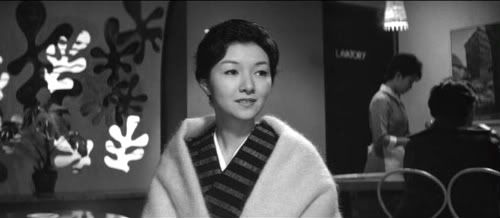
When a Woman... marks my sixth (and, for the moment, final) Naruse - and after traversing my way through the intimate small-town dramas that seem to dominate his 1950s work, this one came as a huge (but pleasant) surprise. From its very beginning, we're told that this will be something quite different: its credits are projected onto a black widescreen vista, accompanied by stark images and punctuated by Toshiro Mayuzumi's vibrant jazz score - thereby marking a notable contrast to the traditional grey introduction (complete with more classical imagery and melodramatic music) that normally opens Naruse's works. The director signifies that this will be a more modernist effort, and he spends the remainder of the film delivering on that promise. Its mish-mash of unrequited love and burning lust gives rise to a cluttered emotional panorama that seemingly marks Naruse's concerted attempt to engage with the afflictions of urban life. That life is rendered magnificently through his impeccable sets, which tend to centre on cosmopolitan bars or lead character Keiko's relatively sophisticated apartment, thereby reinforcing this break from the more homely interiors that Naruse admirers must've been accustomed to at this stage. And then there's the CinemaScope format, which Naruse milks for every inch of its worth. Some of the framing here brought to mind Michelangelo Antonioni, whose seminal L'Avventura was released this same year. Funky coincidence, huh? I actually think that comparison with Antonioni is useful because it's quite revealing... although Naruse's stylizations have effortlessly adapted to reflect his more modern surroundings (therefore allowing for such comparisons to be made), his thematics effectively remain the same and thus, in that distinctly Narusean way that I've come to adore, the director emphasizes the continuity of his standard preoccupations (thus refuting my Michelangelo comparison in the process).

With When a Woman..., Naruse once again shines his cinematic light on the rigidity of the social order and the difficulties that arise when attempting to 'break the mould', so to speak. The issue of female independence is typically at the forefront of his inquiries, and the plight of Keiko functions as a mirror on which to dramatize the conflicts that the thirst for autonomy creates. Although this perhaps makes the film sound more contrived than it deserves? Naruse is always (and I mean always) dedicated to observing his characters in all their naturalistic beauty, in order to genuinely recreate the wealth of human experience. So whilst a number of When a Woman...'s characters behave in ways that surprise us, the director ensures that the machinations of his screenplay remain concealed thanks to his unique ability to preserve that organic 'flow' which defines his best efforts.

And talking of 'flows', there's a similarity between this film and the earlier Flowing re: the way in which both deal with the subject of women as commodities. Obviously, this is more overt in the geisha house of the earlier film, but When a Woman... is shrouded by the issue of money and debt as well, and the glamorous images projected by the bar hostesses are stressed by Keiko as nothing more than mere 'performances' (a point that the film poignantly expands upon with both Keiko and supporting characters such as Yuri) conceived to maximise their monetary gain. The cost of Keiko's desired independence further augments the prevalence of transactions within the film, and the role of money (to purchase her own bar) and its relationship to the patriarchy (she needs patronage) is a central theme here. The film's opening segment establishes Keiko's dilemma: as an 'aging' (she's only 30!) woman in a disreputable profession, she is left with only two options - to open her own bar, or to enter into a doomed marriage (for no "decent" man would apparently desire a woman like her). In both cases, she's dependent upon the patriarchy, and although she tries to manipulate it to her own benefits by gaining capital from numerous patrons in an attempt to resist becoming possessed by a single one, the aforementioned 'organic flow' of Narusean life painfully catches up with her and underlines the difficulty of achieving one's dreams. As a woman, that is.

Keiko is in many ways too outdated for the bustling Ginza district in which she works. She's perhaps too virtuous and moralistic to ever run a truly thriving bar like her rival, Yuri (although, conversely, this adds to her 'appeal' for her clientele). We sense that, had she been born a few years earlier, she would've assumed the role of the antiquated geisha whom she offends during the film's final act, and whose purpose she is uncomfortably replicating in 1960s Japan. Still, the attribute that compels her to continue with her fight is that of perseverance and it's really this sense of endurance (in spite of the suffering) that the film ultimately leaves us with. Visually, the motif of "ascending the stairs" is an extension of this idea. One recalls her own distaste for her profession', yet still she climbs - as if by doing so she'll figuratively rise above jaded reality and towards spiritual harmony. The fact that each of these ascents leads only to the same objectification and 'performance' speaks volumes. It's a continuous cycle, and a ritual that culminates in one of the most poignant finales of a director's career that's seemingly full of them.

Flowing (Naruse, 1956)


Flowing marks the second of Naruse's "geisha" films that I've been privileged enough to watch, alongside the earlier Late Chrysanthemums (1954). The scope of the later film is narrower than Late Chrysanthemums, and its structure much tighter, thus making it the superior dramatization (in this writer's opinion). Moreover, the film boasts an extraordinary ensemble of Japanese actresses: Kinuyo Tanaka, Isuzu Yamada (both arguably icons of these geisha dramas thanks to their collaborations with Mizoguchi?), Hideko Takamine and Haruko Sugimura -- all in the same film! Needless to say, the opportunity to witness so much of Japan's crème de la crème in the same film is not one that should be passed up.

This film is such an intimate examination of the precariousness of geisha life in the 1950s. And it proves to me that Naruse is truly a great woman's director, as he seems so acclimatized to the psychologies of his female characters. He entirely assumes the female perspective here by using Tanaka's character to enter into, and retain an external commentary on, the declining geisha house that serves as the film's main setting. Thus, the audience too is compelled to appreciate the feminine viewpoint. And, typically for Naruse, it's a very poignant one that's on offer: these women are observed both in strength and in weakness, although their increasingly outmoded occupation ensures that it's the latter point that is most pertinent. How Narusean!

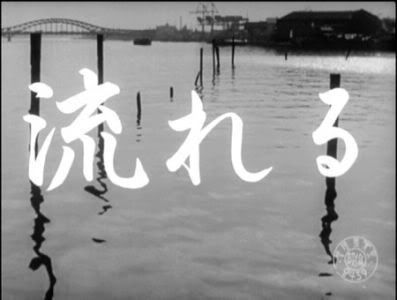
It's the director's ability to (once again) so brilliantly capture the richness of everyday existence that resonates above all else, imo. The film's title is befitting, as it opens with a shot of a flowing river that streams into the next shot of an urban street (a very familiar scene, for anyone acquainted with the director) and closes with the mirror image: a street that segues into the river. Naruse is situating his female crises in the daily 'flow' of modern life, whilst hinting at the continuity of their experiences - after all, the film doesn't really "resolve" any of its plotlines, so to speak.

Nevertheless, Naruse's observations are as acute and rigorous as ever. From the enfeebled-but-determined Madame of the house (movingly played by Yamada) and her vociferous employees, to the conniving 'superiors' who plot behind her back, right down to the two 'external' characters (the daughter, Takamine, and Tanaka's maid) that offer us an alternative outlook in this geisha-dominated environment - Naruse's devotion to, and sympathy towards, his characters is never in doubt. Therefore, one feels the need to give him something of a free pass for the film's one minor flaw (a tendency to become a little too overt with the internalized conflicts), because he and his actresses seem to have earned their right to express their grievances. The film's finale, which contrasts a discouraging affirmation of the geisha lifestyle with equally pessimistic shots of Takamine's forlorn attempts to carve her own future, underlines a world where both traditionality and modernity continue to fail the Japanese women that reside within. Bearing in mind the circularity of this scenario that's enforced by the film's visual bookends, who can really blame these women for letting loose every once in a while? Certainly not Naruse, that's for sure.

Monday, 7 April 2008

Spring in a Small Town (Fei, 1948)


A husband (Liyan) and wife (Yuwen) are physically and emotionally estranged from one another. His friend (Zhichen) pays them an unexpected visit. Unbeknownst to the husband, the doctor turns out to be his wife's former lover, and thus: the central conflict of Spring in a Small Town has been established. If the plot sounds familiar it's perhaps unsurprising, for domestic entanglements and unfulfilled longing exist in fairly orthodox territory for the seasoned cinephile. However, Fei's distinct approach to this material is anything but conventional, and Spring's ingenuity consequently remains very much intact for contemporary audiences. Indeed, it's the director's remarkably adept exploration of his narrative's subtext that initially impaired my own response to the film.

To expand on that last comment: Spring boasts a vast reservoir of disordered feeling, much of which is internalized through the art of performance. Fei (as cinematic technician) is thereby required to supplement his characters' unsettled intrinsicalities using the film's veneer, and although his directorial touch is an expressive one it can occasionally be read as somewhat heavy-handed: intercutting a scene featuring the potential lovers with shots of their designated partners, for example; or the symbolic emphasis placed upon a pot of orchids through the use of repetition. Such judgments threaten to overwhelm the fragility of an otherwise understated drama, but therein lies the film's perplexity: although a delineation between the inferred internal domain and the lucid external one is seemingly apparent, these are interrelated oppositions whose boundaries are constantly breached both physically and figuratively (note Zhichen's entrance into the household). Thus, to misinterpret one is to miscontrue the other, as Fei is really observing the overlap of these two worlds. In its essence, Spring attempts to navigate the gradual movement of its characters away from this opaque middle-ground and towards a new-found clarity, whilst mediating over this precarious transition's necessary confrontations with a host of contentious dualities: heart vs. mind; desire vs. morality; fantasy vs. reality; rebellion vs. conformity.


Spring's conscious decision to underscore proceedings with Yuwen's poignant voiceover enriches this transitory experience for the viewer - rarely has the power of narration been utilized so effectively. Yuwen's apprehensive contemplation subsidizes the film's prevailing melancholia, but curiously lacks a fully coherent affiliation with the main narrative. In some instances, we hear her pre-empting on-screen events; in others, she comments on events that have already occurred; and all the while the audience is plunged into her subjective viewpoint which illuminates those aforementioned dualities. Although beneficial to our comprehension in that sense, the narration is detrimental in another as it obscures the filmic concept of time. [Spoiler:] Aside from the inconsistencies pertaining to its usage, it should be noted that the film's ending visually replicates (and expands upon) its beginning, clearly implying that all preceding events have been born from Yuwen's memory. Despite furthering the depth of our understanding then, Yuwen's voiceover also augments a blurring of fantasy/reality whilst concurrently reconfiguring Fei's mise-en-scène into a dense psychological playground of emotionally-charged imagery.


Accordingly, the film becomes inundated with metaphorical meaning. Previous reservations about Fei's bold intercutting or the use of orchids are somewhat redundant when viewed via the prism of Yuwen's subconscious. Meanwhile, the director's deployment of dissolves in his editing serves as an apt visualization of Yuwen's desires (note how they occur after Zhichen's introduction). Moreover, his frequent return to walls (in the garden, the house, and the all-important "city wall") reflects both the self-made and socially-prescribed barriers that contain Yuwen's passion; whilst their noticeable disrepair fortifies the authority of the emotional (their imbued status as life-governing boundaries) over the physical (their clear fallibility) that permeates the film. So exquisite is Fei's construction that even the patterning of doors and doorways plays into this exposition of interiority: the stark, rectangular designs acribed to the males form a contrast against the complex and elaborate decorations in Yuwen's quarter.


Although her presence dominates the film, Yuwen's introspection is not at the expense of others - Fei's camerawork remains committed to all of Spring's characters. The actual gaze of the film frequently articulates the infiltration of subjectivity (the narrative dictates that this is her perspective) into objectivity (the visualization is often something that she couldn't possibly have seen). Take for example, the scene in which Yuwen and Zhichen undergo their initial walk: at one point, Fei films them from behind at considerable distance as the two have a dispute expressed entirely through gestures. Yuwen would never have recalled the event from such a position, but her subsequent instincts dictate a repression of such incidents, thereby complementing Fei's own intention of veering the film away from the melodramatic. Of course, there are also the numerous instances when Yuwen isn't even in the scene, and in these cases Fei simultaneously: explores the wandering mindset of a woman seeking a resolution; questions the validity of her memorializing; and provides opportunities for the audience to sympathize with other characters. And indeed, each of these characters is sympathetic - if any of them are even remotely demonized it's Yuwen herself, who is depicted as the quiet aggressor with both Liyan and Zhichen, and seen as (self-?)isolated in scenes featuring the 'familial' collective.


Yuwen's wilful detachment from her family could arguably reflect a disconnect with a changing society, although Fei's film is never overtly allegorical. Nevertheless, the fact that the Communists rejected the film suggests that there are ideas waiting to be explored here. One could examine an tenuous link between Yuwen's frustration and the evident destruction caused by years of war (briefly alluded to during Zhichen's arrival). Additionally, using their clothing styles as a platform, we could feasibly interpret the characters of Liyan and Zhichen as representative of the (admittedly simplified) values of traditionality and modernity, with the former's illness reinforcing his derogatory role as the 'Sick Man of Asia'. Bearing this in mind, Fei's tender-hearted treatment of Liyan might well have been problematic for Leftist thinkers, and Spring's finale - which sees [Spoiler:] Yuwen conclusively opting for the traditional over the modern - amplifies this dilemma.


Could Spring therefore be conceived as an effort to engage with the issues facing a war-torn nation? Perhaps, but the film's enormous power derives primarily from its success in penetrating the intricate psyche of its lead character. Political commentary, however slight, is inevitable given the historical context that manifests itself in the film, but it's also tangential to the primary investigations of love, honour and duty. As it's these concerns that motivate Yuwen's final decision, it's on these terms that they should be judged. [Spoiler:] In reality then, her resolve to repair her own world instead of escaping to pastures anew is an optimistic one, albeit one with a self-sacrificial element to it. Lest we forget that Liyan also undergoes a significant change: initially, Yuwen describes him as having "no courage to live"; later, he himself states that "I have to get better, I have to go on living." Thus, his character's movement from opacity to clarity is decisively complete, and although Yuwen's personal transition is an ongoing process, there's no reason to believe that the future will be as desolate as the past. The fact that these changes have been (ironically) instigated by her forbidden love is perhaps an extension of the story's pure compassion for its characters, for in charting their journey the film posits love itself as a redemptive and potent force for change. If this is political conservativism, then let it be said that the world is in need of more such 'undesirables.'