 Sokurov's latest film casts his titular heroine as a defiant Mother Russia figure who's as eccentric as characters get in his closed artistic universe. Aleksandra's visit to her grandson, stationed at a military barracks in Chechnya, offers the director a rare opportunity to comment on contemporary regional turmoils. Those familiar with films such as The Sun however, will soon realize that Sokurov has minimal interest in politicizing his threadbare narratives. Instead, he typically elevates his film unto a plane above everyday reality: characters don't talk so much as they mumble against the audible gasps of their desolate environment; deliberately poor dubbing gives the effect of dialogue emanating from the subconscious; and all the while, a plaintive symphony interpolates the soundscape, punctuating the most emotionally-charged moments with a heavy dose of appealing irony. Sokurov's imagery remains as beautifully stark as ever, appearing as if saturated by a celestial presence that leaves the natural looking artificial. It is against this backdrop that Aleksandra and her companions can be caught moralizing with jarring frankness - their strained confessions forming the discursive backbone of the director's poetic ruminations on the wayward Russian spirit. This rambling approach to so substantial a subject pays dividends: the national question, stifled by Sokurov's elegiac construction, both transcends and relapses into something more akin to intimate self-analysis. The very notion of Russian identity is deconstructed into an abstract conflict of spiritualism vs. realism. Aleksandra embodies the former, her grandson the latter, and in his tender examination of their familial bond Sokurov charts the ebbs and flows of this most peculiar conception of nationality. Even if his evaluations are lacking and somewhat misguided in their political foundations, his crisis of the Russian soul's moody allure strikes a chord that's as relevant as much as it is resonant. When Aleksandra's Chechen counterparts bid her farewell at film's end, their outpouring of affection may well have concluded the most crushing fantasy of the 21st century.
Monday, 22 September 2008
Aleksandra (Sokurov, 2007)
Sokurov's latest film casts his titular heroine as a defiant Mother Russia figure who's as eccentric as characters get in his closed artistic universe. Aleksandra's visit to her grandson, stationed at a military barracks in Chechnya, offers the director a rare opportunity to comment on contemporary regional turmoils. Those familiar with films such as The Sun however, will soon realize that Sokurov has minimal interest in politicizing his threadbare narratives. Instead, he typically elevates his film unto a plane above everyday reality: characters don't talk so much as they mumble against the audible gasps of their desolate environment; deliberately poor dubbing gives the effect of dialogue emanating from the subconscious; and all the while, a plaintive symphony interpolates the soundscape, punctuating the most emotionally-charged moments with a heavy dose of appealing irony. Sokurov's imagery remains as beautifully stark as ever, appearing as if saturated by a celestial presence that leaves the natural looking artificial. It is against this backdrop that Aleksandra and her companions can be caught moralizing with jarring frankness - their strained confessions forming the discursive backbone of the director's poetic ruminations on the wayward Russian spirit. This rambling approach to so substantial a subject pays dividends: the national question, stifled by Sokurov's elegiac construction, both transcends and relapses into something more akin to intimate self-analysis. The very notion of Russian identity is deconstructed into an abstract conflict of spiritualism vs. realism. Aleksandra embodies the former, her grandson the latter, and in his tender examination of their familial bond Sokurov charts the ebbs and flows of this most peculiar conception of nationality. Even if his evaluations are lacking and somewhat misguided in their political foundations, his crisis of the Russian soul's moody allure strikes a chord that's as relevant as much as it is resonant. When Aleksandra's Chechen counterparts bid her farewell at film's end, their outpouring of affection may well have concluded the most crushing fantasy of the 21st century.


Sunday, 21 September 2008
Stazione Termini (De Sica, 1953)

 Jennifer Jones furrows her brow, Montgomery Clift flares his nostrils, and together they strive to breath life into the sterile romance that debilitates Vittorio De Sica's bizarre Stazione Termini (1953). Unfolding entirely inside Rome's titular train station, the accomplished director's English-language debut seems to draw clear inspiration from David Lean's Brief Encounter (1945), whilst anticipating his later Summertime (1955). De Sica embroiders an entirely different emotional fabric however: the romantic impulse is substituted for illicit carnality, and the tender, empathetic perspective that one associates with Lean's intimate dramas is noticeably absent. It remains unclear if this was De Sica's intention, or whether this is simply a byproduct of the execrable performances from his distinguished stars. Clift's brooding hyper-intensity is humorously undercut by his wavering attempts at an Italian accent, but all worst in show honours surely belong to Jones whose underwhelming "damsel in distress" schtick conveys as much human resonance as a brain-dead pig. With lipstick. And Dior.
Woefully misguided as the actors are, one must surely attribute some of the blame here to the film's creative team. A collaboration between screenwriters of such pedigree (Cesare Zavattini and Truman Capote are amongst the contributors) has no reason to feed the stars such laughably trite dialogue, nor should it facilitate such a conservative message (the maternal archetype is venerated beyond belief). And as for De Sica, Stazione Termini finds the filmmaker caught in perpetual limbo between the social documentarian of neorealism's heyday and the metteur en scène demands placed upon the Hollywood melodramatist. The ensuing awkwardness manifests itself in more than just the acting: the director lingers upon shots of ordinary people long after the stars have left the frame, evidently struggling to tailor his auteurial instincts to the conventions of continuity editing. His approach would seem refreshing if it refrained from painting its innocent bystanders as participants in an urban freakshow - what does one make of the vertically-challenged Kirk Douglas lookalike who drools over anything with a vagina and angrily clings to an orange? Or how about the gaggle of eccentric clergymen who overwhelm the screen at the most random intervals? And the crazed policeman-as-pervert who pulls "Fuck me!" faces at Jennifer Jones, of all women? De Sica may be attempting to represent the discomfort and shame felt by Jones's guilt-ridden adulteress, but he ends up creating a cross-section of Italian society that reveals a worrying sense of national self-loathing.
Like so many other entries in the genre of directorial missteps however, Stazione Termini has its merits. De Sica shows a mastery of visual style here that might surprise the viewer. The vibrant hubbub of the station is frequently wedded to expansive long-shots that revere the near-glacial beauty of its architecture. What ensues is an abiding feeling of disconnection from space and time (note the giant clocks that the director so often returns to) - and, given the iconic location, modernity. The director draws attention to this with the deftest of touches: shot/reverse-shots used during the lovers' conversations discreetly position each participant at opposite ends of the frame, highlighting the distance that separates them (and accentuating the moments of intimacy when they do share the frame). Moreover, at one point, Jones's face is filmed from a high-angle with toplighting, evoking memories of Dietrich, Garbo and the exoticized splendour of the fallen woman. The actress's ineptitude is advantageous here, drawing attention to both her characters' detachment as a clueless American in Italy, as well as her personal disconnect from the proponents of the shot's prototype.
De Sica's insinuations regarding the perils of modern life are admirable, going so far as to create an alternative narrative simply through the strength of his potent imagery. When the actual, contrived narrative - complete with its dour eroticism, simplistic orthodoxy and stultified emotional masochism - concludes with what is quite possibly the most elongated and laborious farewell in the history of forever, he might well have given the audience enough reason to wonder whether their feelings of nonchalance after ninety minutes of intensive "romantic melodrama" are intended.
But this is still a crock o'shit.


On Dangerous Ground (N. Ray, 1952)
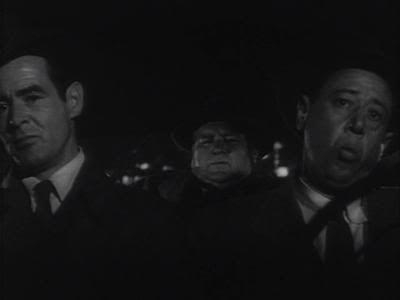 The cineaste's inherent need to categorize is masterfully exposed by Nicholas Ray's On Dangerous Ground (1952). With Bernard Herrmann's dynamically sinister score providing a serrated edge to the murky cityscapes of the opening credits, one could be forgiven for assuming that this is a film that will conform to the conventions of the urban noir. And indeed, for almost half an hour the director revels in the seedy underbelly of his dystopia, where perversity and profanity collide in a flurry of violence amidst the shadows. Credit the ominously restrained (for the most part) fervour of Robert Ryan's tortured police officer for grounding this segment with a psychological quandary that demands a resolution: how is it possible to survive in the gutters of society without losing one's humanity? In pursuit of those depths, Ray sends his cop on an ontological odyssey into the wilderness, via the morbid conceit of a manhunt for a murderer. Although the stylistic values of the noir appear to have evaporated, in the snow-covered desolation of the countryside the director locates the same crisis of morality that plagues the city. Accordingly, the film becomes a study of man in relation to his environment: in both locations, Ray follows his low-angle shots of the inhumanly tall Ryan with long-shots where the actor seems dwarfed by his ultimately empty surroundings. But all is not lost - without the neverending activity of urbania to shield him, Ryan's cop is at his most vulnerable. And then... he discovers Ida Lupino, blind yet resilient, and readily capable of empathising with his spiritual isolation. With a series of penetrating close-ups, Ray breaks down the defences that the pair have constructed against the world, and thereby emancipates their wounded souls. In mutual heartbreak and weariness, the duo enact a filmic ballad of loneliness that redefine the once unnerving snowy exteriors as a poetic source of revitalization. Ray has deceived the viewer: this is about the environment in relation to man, and the latter's potential to change it for the better. But this is no Hollywood ending: [Spoiler]it takes a death to enliven these hearts, and it requires the protection of blindness for them to thrive - the director is all too aware of his happy facade.[/Spoiler] No matter, in both reality and fantasy, the audacity of Nicholas Ray's filmmaking makes for nothing less than scintillating viewing.
Summer Interlude (Bergman, 1951)
 Summer Interlude (1951) is often acclaimed as the best of Bergman's early features. And indeed, there are stretches here that suggest that the film does deserve to stand alongside the glories of later years. Not until Fanny and Alexander over three decades later would Bergman evoke the naivety of youth in quite so enchanting a manner. With Interlude, the director focuses his attention upon sexuality and, more specifically, the increasing sexual awareness that's integral to the adolescent experience. To romanticize his concerns, Bergman conjures up a noteworthy brand of visual lyricism, defined by its dependence upon the natural world. Benefited heavily by Gunnar Fischer's ability to capture so many resplendent moments on film, the director draws a scintillating - if somewhat simplistic - parallel between one's sexual awakening and nature in full bloom.
Bergman clearly has his finger on the pulse when it comes to imagery, but with the film's other elements he stumbles considerably. His frank, penetrating dialogue always has the potential to be read as overbearing and heavy-handed, and with the benefit of hindsight, Interlude verges dangerously close to self-parody. Its characters espouse lines that will sound familiar to anyone with Bergman's work - "Is there no meaning to life?", "Why has God forsaken me?" etc. - but the artistry of the director's later films often allow for such gloomy statements to be organically born from his mise-en-scène. After appearing so concerned with the natural, Bergman's dialogue here seems anything but. At one stage Marie, the film's lead, stares at her uncle's hands and randomly announces: "I stand here looking at your hands... they're beautiful, yet somehow ugly." The viewer can't help but laugh. Bergman in 1951 is a visibly accomplished director, but not one that can yet iron out the flaws and contrivances of his scripts with an assured hand. (Note the scene where he resorts to using a distinctly unterrifying owl's hoot to ratchet up the tension.) Without the assistance of the idyllic summer scenes, his film grinds to a tedium-inducing halt by the time of its finale.
But despite his own attempts to sabotage his work during its conclusion, Bergman struggles to dispel the memories of what preceded it. His captivating portrait of young love may seem a little excessive at stages, but it's somehow appropriate considering how so much of it is underscored by an intensely mournful perspective. Moreover, the director's ambition often makes for fascinating viewing: consider the sprightly morbidity of a bizarre animated sequence! Or revel in an early template for THAT scene, where an eccentric aunt plays a game of chess with a Priest who has the nerve to comment: "I feel as if I'm sitting next to Death himself!" For the Bergman enthusiast, it's a privilege to witness the master experimenting with such familiar ideas. The role of performance in this narrative, and the preoccupation with theatre and the internal worlds of its artists, surely plays into this. (As a sidenote, the film features a couple of absolutely ravishing ballet sequences that augment these concerns.) Meanwhile, his gentle allusions towards sex and desire assist the film in its refreshingly modern approach to matters of the heart (not to mention other organs). There's even the suggestion of Bergman's first gay coupling in a pair of old, gossiping theatre clerks. Summer Interlude may be too convoluted to join the ranks of his greatest achievements, but there's enough creativity here to ensure that it stands the test of time on its own merits.
Tuesday, 26 August 2008
Madame de... (Ophuls, 1953)
Writer's Note: Do NOT under any circumstances read my thoughts if you haven't seen the film!
 The filmography of Max Ophuls arguably lends itself better than most to the auteur theory. It's an oeuvre that mirrors its creator's national displacement - he made films in five different countries - but despite the personal upheavals, Ophuls nevertheless managed to spend almost a quarter of a century redefining and then refining the art of the cinematic romance. The language of his dialogue may be dependent upon location, but the director's film language is a constant that remains instantly recognizable: the glistening surfaces of his sets; the meticulously choreographed camerawork; the motifs of movement that support his enactments of desire in motion; the dominance of the dance and the duel; and the melodramatic yet evocative compositions that painfully underscore the naked heart of his cinema. The circular and cyclical structure of the director's biggest popular hit, La Ronde (1950), can well be applied to the entire output of a career that finds him reusing and remoulding themes, symbols and even entire scenes in order to augment the sense of predetermination that intrigues so many of his characters. Bearing his particular concern with European history in mind (a turn-of-the-20th-century backdrop informs many of his most acclaimed works), it is perhaps fitting that Ophuls's own cinematic past should so invariably inform his present.
His penultimate achievement, Madame de..., represents the culmination of this creative phenomena. Not only does it bear the auteurial stamps that were cited earlier, but it also draws from his preceding efforts in a manner that identifies the film as the pinnacle of his craftsmanship - eventually attaining a type of postmodern singularity by means of its plurality. Although not strictly necessary, a basic comprehension of the cinematic roundabout that is Ophuls's oeuvre deepens the subtleties of Madame de..., whilst concurrently accentuating the passions that enflame its core. Here lies the circularity of La Ronde, the masochism of Letter from an Unknown Woman, the stylistic excesses of Le Plaisir, the historical evocations of De Mayerling à Sarajevo. Note also: the pre-eminence of a single object; the obligatory train station scenes; the centrality of an opera house; the inescapable presence of the military. All of these traits persistently manifest themselves throughout the director's work, but nowhere do they coalesce within a single film as supremely as they do here. Appropriately, Madame de...'s inevitable conclusion operates on a dual front: through the strength of Ophuls’s storytelling; and via the weight of the director's past tales. The final, definitive action of the film and the events that lead up to it suggest that it is not simply Louise, the General and Donati who are entangled within these hands of fate. Their love triangle is the final and greatest entry in a star-crossed line that stretches back over two decades, encompassing: Lisa and Stefan from Letter; Sophie and Franz from Mayerling; and, most directly, Christine and Fritz from Liebelei. Each lover’s failure to transcend their physical milieu is glaringly exposed by this director’s ability to figuratively traverse space and time with such enviable ease.
 Valid discussions of Ophuls’s career are of course impossible if one bypasses the role of women in his work. The director’s feminist credentials can well be debated (are women not merely the most accessible and arguably effective tools with which to examine the more pertinent matter of love and its relationship to the social order?), but his consistent alignment with female characters cannot. 1934's La Signora di tutti receives numerous citations as the film where the mobile, Ophulsian camera of the 1950s first rears its head. Yet it remains equally significant for the development of its female-driven narrative, whose deconstruction of celebrity provides early prep work for 1955's more renowned Lola Montès. Signora's muddled interspersion of gaiety and tragedy struggles to locate the harmonious equilibrium of later films, but the presence of the ultimately sympathetic female protagonist is crucial. In so many of Ophuls's narratives conflict emanates from a woman's heart, and Signora illustrates this at its earliest stage. Feminine desire is forever engaged in a battle against the social order, and the dramatic friction caused by two such powerful, vital forces spills over into the everyday - a woman's revolt against society becomes an urgent struggle against other individuals and the self. By 1953, Ophuls excels in the transmission of such concerns, and thus the fractured characterizations and overt sensationalism that undermine Signora's tragic undercurrents are replaced with the intricately-drawn participants of Madame de...'s ill-fated love triangle, here supplemented by a melodramatic framework that magnifies the tragedy by unearthing its nuances instead of encouraging its histrionics.
One can also find a unique sense of bliss in the director’s image-conjuring prowess. Madame de...'s entrancing presentation of the Parisian Belle Époque is emblematic of his later films' expertise in realizing success on a base, though nonetheless intoxicating plane where luxurious artifice equates to unabashed viewing pleasure. And yet for many casual observers, Ophuls's visual flair either belies the integrity of his sentimental scenarios, or predicates a taste for surface sheen over narrative substance. To side with such charges however, is to ignore the acumen with which the director executes his magisterial vision. In Madame de... every track, every pan, every prop and every ray of light contribute to a suave exercise in cinematic deception. To borrow a prominent example, the trademark fluidity of Ophuls's camerawork embodies an interfilmic binary opposition through its ability to impart both liberation (acting as a spiritual extension that provides temporary release from the corporeal), as well as incarceration (by defining the parameters of this escape), all the while veiling its intents behind a shroud of dignified hyperactivity. A camera that is as happy to waltz with its subjects as it is to magically glide through walls understandably poses a threat to a hardened aesthete's resistance - but the illusory experience on offer in Madame de... is just that: a mask that disguises the camera's active participation in content as well as style.
 Concealed depths such as these are not just restricted to traditionally stylistic devices. A series of ironies and evasions perfuse the dialogue also, thus revealing the chasm between the characters' self-constructed exteriors and the realities of their internal yearning. Throughout their courtship, Louise insists to Donati: "I do not love you"; although neither lover nor audience believes this proclamation for a second, with the conspicuous lie betraying an antithetical truth. One of the heated encounters during the film's final act finds the General falsely accusing Donati of calling "the army, and consequently its generals... useless!" Donati says no such thing, but admits to the crime as a penance for his forbidden love - a topic that cannot enter the forum of public debate. And early on in the film, Louise and the General participate in a delicious tête à tête regarding the earrings' whereabouts. Their shared rapport is attractively transparent during verbal exchanges where the audience is privileged with the knowledge that both parties are deliberately suppressing their awareness of the truth to win greater gain from their significant other. Yet even in a comedic encounter that radiates as much warmth as this, narrative and visual style work in unison to intensify the film’s emotional canvas. Despite reinforcing the pair’s companionship with a sequence of shot/reverse-shots in close-up from their respective beds, the director employs an 180˚ pan to precede the sequence and two long-shots to conclude it, both sharing the same purpose: to divulge the startling distance between the sleeping quarters in question. Charm, vivacity and mutual affection may characterize the tone of this scene, but Ophuls typically ensures that it is a somewhat dispiriting lack of romance which the viewer is ultimately left to ponder.
Tellingly, marital vows in Madame de… are not far removed from those in other Ophuls pictures. Liebelei, La Ronde and Le Plaisir all to some degree depict the carefree attitudes with which certain partners treat their prescriptions of monogamy. Madame de…’s thorough exploration of frivolity’s limitations - which eventually unravel its characters’ pretences - allows it to differentiate itself from its predecessors with a triumph of depth. Late into the film, the General provides a remarkably bold and self-reflexive analysis of his predicament to Louise: “Our marriage is a reflection of ourselves. It seems superficial only superficially.” Both character and director effectively dare the viewer to better scrutinize story and frame, as the General’s startling recognition of his façade points towards intelligence undervalued. Moreover, the self-confessed undertones of role-playing allow us to presume that any shortfall in the romantic stakes has less to do with the couple themselves and more to do with the privileged positions that they enjoy within their social hierarchy. Their marriage may be a reflection of themselves, but they in turn are a reflection of society - at least, superficially.

 To elucidate the weight of the social obligations placed upon the haute monde, Ophuls frequently returns to scenes that involve communal gatherings. Lavish balls and operas prove indicative of the trivialities that plague a patrician’s schedule, whilst more serious-minded endeavors such as diplomatic meetings or hunts and duels function primarily as platforms for destruction. The seemingly irreconcilable subjects of fun and death hereby converge to define the director’s near-decadent portrait of elite social structures. True romance’s inability to persevere in such a habitat should therefore come as little surprise. Although its members are readily capable of emotional gravity, Ophuls’s high society is built upon a foundation of hollow joviality that constrains the emergence of feelings as potent as that of love. Hence, its textual absence until the arrival of a relative outsider thirty minutes into the film.
If the suppression of love is an issue for the aristocracy, then it is a problem amplified in the case of its women. With its suggestive title and its creator’s experience, Madame de… flourishes in the arena of gender politics, and a true to form Ophuls commits himself to imbuing the film’s every frame with an underlying commentary on the veiled sexism of the era. His aims are complemented by a narrative that parallels Louise’s extramarital impulses with that of the General’s, before investigating the ensuing hypocrisy that the contrast generates. Whilst society sanctions the husband’s apparent right to pursue sexual relations with another partner (his mistress, Lola), it simultaneously curbs the desire of the wife, whose genuine love for Donati is denied the opportunity for consummation. This basic inconsistency is key to Madame de…’s development, for the early revelation of the General’s adultery casts a permanent shadow over Louise and Donati’s romance, acting as a perpetual reminder of the inequality inherent within the marital couple’s partnership.
 Ophuls’s opulent mise-en-scène is never more alive than when expanding upon this theme. From the outset, the director instigates a dynamic cinematic correspondence with the viewer that deepens his plot with coded imagery. The lauded opening take of the film lasts for approximately two and a half minutes, and as Louise briskly mulls over her possessions (her debt as yet unknown to us), the camera effortlessly skims around the room with her. In a tantalizing move, Ophuls refuses us an unobstructed view of his heroine for over half of this take, instead opting to interrogate her ornate surroundings - dominated by innumerable jewels, furs and mirrors. When the mystery of Louise’s face is finally revealed to us, she appears not in front of the camera, but as a reflection in one of these dressing-table mirrors. Thus, she is promptly divulged as another constituent in the commodity-infested environment on-screen. Although Louise’s gaze stares back at the audience, her physical presence as the film’s subject is overwhelmed by the multitude of surrounding props, motivating her retreat into objectification. Our perception of the aforementioned commodities thereby undergoes a significant transition: no longer are they mere symbols of wealth and power, they now morph into instruments of covert patriarchal oppression - symptomatic of a “trophy wife” culture that’s adhered to all too fervently. In hindsight then, it is uncomfortably incongruous of Louise to state that “…I can do as I like with them,” when discussing her valuables this early on. Her chimera of independence is negated by the exact materials that furnish her fantasy.
As if to thwart any lingering doubts that the viewer might have about Ophuls’s thematics, the scenes that immediately follow his bravura introduction conspire to consolidate Louise’s commodification. Over breakfast, she is confronted by a looming portrait of the General that establishes his authority as the archetypal patriarch, not to mention her diminutive figure in relation to the social order, over five minutes before he makes his first physical appearance in the film. After leaving her home Louise visits a church, in which she visibly arouses the interest of a praying soldier, before reaching her intended destination at a jeweller’s (Monsieur Rémy’s), where she again causes titillation as both the tradesman and his son struggle to contain their own desires. At each of these stages Louise is able to either ignore or spurn the attention showered upon her, but never is she able to entirely reject her elemental status as a receptacle of the male gaze.
 Curiously, for a notable portion of the film Louise actively revels in this socially-sanctioned role. During the film’s first act she cheerily absorbs male affection and cultivates a reputation as a sort of sophisticated coquette. It is a position that her husband both observes - “she is adept at making you die of hope” - and accepts: “A pretty wife is meant to be looked at.” In a context where gender equality is palpably absent, Louise’s simple concessions to her voyeurs enable her to manipulate the prevailing male attitudes of chivalry and lust to a limited extent, thereby granting her a minor but nonetheless important degree of control within her social circle. In spite of this victory, the budding relationship with Donati later in the film provokes Louise to relinquish her privileges in favour of an all-consuming romance: “I hate society. I want no one to look at me but you.” In actuality, the concept of self-objectification is so ingrained into her mindset that her defiance is rendered a delusion. Louise may attempt to reject collective demands, but by immersing herself so wholly into an individual’s gaze she finds herself entrapped within a different social norm bound by the same stipulation: an existence that is to be defined by her male admirer(s).
Louise is thus incapable of negotiating herself a status greater than that afforded to the possessions that she so cherishes. In essence, she remains another thread in the materialistic drape that blinds the nobility. It is therefore ironic that her life should come to depend so heavily upon the earrings referenced in the film’s (unfortunate) American title. If Louise is exemplary of the patriarchy’s propensity for objectifying its subjects, then the earrings conversely relay its ability to substantiate its objects. Their initial worth is minimal: relics of a marriage contract that each partner treats with merry nonchalance. When Donati miraculously returns them to Louise however, they assume the romantic significance that should arguably have always been assigned to them. It is the discord in personal value between the General’s original gift and Donati’s emotionally-repackaged version of it that triggers the former’s determination to remove them from Louise’s grasp, escalating their price towards even loftier heights. By the finale, they are so value-laden that they undergo a metamorphosis from recreational commodities to religious exhibits. In other words: they become priceless.
 Although the narrative suggests that Louise’s original transaction occurs due to her debts (as well as an implicit need to protect her husband’s prestige), the film’s peculiarly nameless title and the cause-and-effect frameworks that link the earrings to Donati (and therefore, love) hint towards alternative reasoning: a subconscious longing on Louise’s part to escape the confines of her marriage. Standing against her is a patriarchal clasp on Madame de…’s theatre of exchange that is especially rigid, as demonstrated most clearly by Monsieur Rémy’s consultations with the General. The jeweller’s betrayals of Louise’s misplaced confidence stifle her inadvertent rebellion, administering her passivity in an economic sphere that restricts marketplace activity to men. Meanwhile, Rémy’s visitations to the General’s barracks additionally help to establish a visual association between the military and the return of the earrings, binding the latter to an ultra-masculine order that repeatedly lures them back from their misadventures. It is only her husband’s refusal to re-purchase the jewellery at a critical juncture that allows their escape from this system, meaning that Louise’s triumph over the rules of trade is a virtually empty one. Furthermore, she exchanges almost all of her valuables to regain the earrings, an act that violates the social codes that her possessions represent. By disregarding la règle du jeu, Louise sets into motion the chain of events that will drive both her and Donati to their ruin. This is the cost of forbidden love in Ophuls’s world.
A specific distaste for patriarchal regulations permeates much of the director’s work, and with the evidence thus far one could certainly argue that the trait is most pronounced in Madame de…. Fortunately, Ophuls is sagacious enough to prevent his art from descending into misandry. The film may condemn the status quo, but it sympathizes with everyone that it subjugates. Ophuls counterbalances Louise’s woes with the subsequent repression of the men around her, observing that both the General and Donati are suffocated by the very system that endows them with their primacy. That the latter should meet his end thanks to a duel with the former only compounds this issue. Throughout his career the director casts a critical eye upon this socially-acceptable contest of “honour”, though he lambasts the doctrines that permit it rather than the individuals that perform it. This conflict’s victim is perhaps the least interesting member of the film’s romantic triumvirate, but he is also its most important catalyst. It is Donati’s arrival that propels Madame de… to its giddy highs and its cataclysmic lows, and with his loss both Louise (whose fate becomes entwined with his own) and the film helplessly expire. If his need to look up “desire” in a dictionary and his willingness to terminate relations with the heroine invites the viewer’s suspicions, then his resigned fatalism during the final confrontation scenes emphatically dispels such doubts. When Louise questions him - “You do no longer love me…?” - Donati’s failure to respond implies that his decision to fight is a harrowingly necessary one: death is now more preferable than the burden of a broken heart.

 Donati’s murder/suicide further tarnishes the filmic standing of the General, whose effective implementation of social protocols means that of the film’s leads, it is he who veers closest to reprehensibility. However, looks always deceive in an Ophuls picture, and the General is relieved of potential villainy by the director’s careful assertions of his vulnerability. Whilst his breakfast-room portrait that was noted earlier does indeed have a foreboding presence, it is the disparity between role and reality that strikes a chord with the viewer: the charming, urbane and surprisingly short man married to Louise is a far cry from the tall, imposing and authoritative figurehead of the painting. In a much later scene where the General attempts (and fails) to exert this authority by dissuading Louise from leaving Paris, he restlessly begins to shut all the windows in his house. Borrowing a technique from Le Plaisir, Ophuls shifts perspective by cutting to an external tracking shot to document this action. The camera’s placement outside the zone of activity allows it to assume the gaze of an extraneous influence at the precise moment when the General locks himself and Louise inside their home. Had the camera been placed behind him, one could have asserted that the General was in control of this decision to entrap; but by venturing beyond the initial line of vision, Ophuls implicates society for the filmic snare and indicates that this patriarch is as fundamentally enslaved by its conventions as his wife. As he himself poignantly conceded earlier in the film: “We are not our own masters… especially a general.”
This revelatory statement is spoken during the departure scene of his mistress, Lola, and is echoed later on by a near-identical episode with Louise. A comparison of the two incidents unearths the depth of the General’s feeling for his wife. His overall demeanor with Lola is a continuation of the playful ebullience with which he is initially synonymous: he seduces, bids his farewells and exits without once looking back. By contrast, Louise’s departure induces his first visible signs of melancholia, and as her train leaves he gazes forlornly at the mechanisms that pull his wife away from him. In another of the film’s many ironies, it is Lola who receives the farewell kiss on the lips, with Louise settling for an unnervingly formal peck on the hand. The General’s superficial lifestyle and his adherence to militaristic codes have paralyzed his confidence in genuine matters of the heart. Of all the characters in the film, it is he who suffers the greatest divergence between their public and personal identities.

 Madame de…’s great tragedy then, is that all of its leads experience an epiphany during the course of the film. Take Ophuls’s euphorically informative visuals out of the equation and they begin, on paper at least, as shallow and careless individuals, content to wallow endlessly in their merry masquerades. As their character trajectories progress however, each of them undergoes a radical change. The introduction of passion into the narrative engenders a process of humanization that coincides with an increasing awareness of their desires. Unfortunately for them, these desires also unravel their orderly lives, heightening the need to restore the frivolous standard and imprisoning them within roles that they no longer wish to play. And with the comings and goings of the earrings constantly sculpting the film’s emotional panorama, one begins to comprehend just how irrevocable society’s materialism really is.
Materialist ethics go so far as to infiltrate the domain of the spiritual. “My cross?”, says Louise in the opening scene when evaluating her possessions, “Oh no, I adore it!” Her actions in the film affiliate religion with the prevalent world of transactions, but neither she nor Ophuls ever lose sight of its intensely personal value. Towards the end of the film, Louise visits a church and begs a saint to accept her treasured earrings as a suitable exchange for Donati’s safety. The saint’s apparent “refusal” to enter into this bargain says less about the absence of the divine than it does about the worth of life itself. Ophuls uses Louise’s act of desperation to delineate between the institution of the Church and the integrity of private faith: it is the former that accepts the gift and presents them in their most fetishized form at film’s end; it is the latter that reassigns the ethereal relevance entrusted to the earrings unto Donati’s existence. The celestial powers-that-be thus reveal themselves as the only abstract forces in the film that esteem the invaluable beauty of the human spirit over the metallic perfection of the earrings. In freeing Donati and consequently Louise from the shackles of society, it could be argued that the saint does, in actuality, grant her wish. The film’s seemingly tragic finale allows the couple to relocate their love to the only realm in which it can possibly survive: the afterlife.
 There is a sequence in Madame de… whose reputation is nearly as great as the film’s own. It can be summarized as a dance between Donati and Louise, but to describe it as such seems a woeful miscarriage of justice. It is more akin to an elegant roundelay of passion, charged with all the urgency of repressed desire. As the two admirers waltz, the director’s camera seamlessly cuts and dissolves around them, layering emotional subtexts onto one another and completely disregarding time whilst remaining all too aware of the threat that it poses. The cumulative effect of all this is overwhelming, compelling the audience to surrender themselves to the impeccably crafted-insularity of the burgeoning love that saturates the frame.
It is this enchanting sequence that best encapsulates the spirit of Ophuls’s magnificent art. Supported by his camera’s graceful choreography, the director concisely articulates the importance of pure sentiment in environments where they are consistently marginalized. Moreover, he excels in charting the progression of such feelings: during a five-minute ballroom routine Ophuls can leap at will from formality to informality, from vacuity to cognizance, and most importantly from frivolity to love. For this artist, such oppositions work in symbiosis to enrich the texture of his films, and his penultimate effort exemplifies these contradictions at their finest. It enamours with its celebration of the superficial, only to take apart its own convivial artifice once the viewer is on side. When its masquerade is eventually unclothed, there lies a film that exalts love as the greatest emotion that one could ever know. In denying this joy to the characters with whom it is so acutely attuned, Madame de… proves itself to be the most cynical of all cinema’s great romances.


 The filmography of Max Ophuls arguably lends itself better than most to the auteur theory. It's an oeuvre that mirrors its creator's national displacement - he made films in five different countries - but despite the personal upheavals, Ophuls nevertheless managed to spend almost a quarter of a century redefining and then refining the art of the cinematic romance. The language of his dialogue may be dependent upon location, but the director's film language is a constant that remains instantly recognizable: the glistening surfaces of his sets; the meticulously choreographed camerawork; the motifs of movement that support his enactments of desire in motion; the dominance of the dance and the duel; and the melodramatic yet evocative compositions that painfully underscore the naked heart of his cinema. The circular and cyclical structure of the director's biggest popular hit, La Ronde (1950), can well be applied to the entire output of a career that finds him reusing and remoulding themes, symbols and even entire scenes in order to augment the sense of predetermination that intrigues so many of his characters. Bearing his particular concern with European history in mind (a turn-of-the-20th-century backdrop informs many of his most acclaimed works), it is perhaps fitting that Ophuls's own cinematic past should so invariably inform his present.
His penultimate achievement, Madame de..., represents the culmination of this creative phenomena. Not only does it bear the auteurial stamps that were cited earlier, but it also draws from his preceding efforts in a manner that identifies the film as the pinnacle of his craftsmanship - eventually attaining a type of postmodern singularity by means of its plurality. Although not strictly necessary, a basic comprehension of the cinematic roundabout that is Ophuls's oeuvre deepens the subtleties of Madame de..., whilst concurrently accentuating the passions that enflame its core. Here lies the circularity of La Ronde, the masochism of Letter from an Unknown Woman, the stylistic excesses of Le Plaisir, the historical evocations of De Mayerling à Sarajevo. Note also: the pre-eminence of a single object; the obligatory train station scenes; the centrality of an opera house; the inescapable presence of the military. All of these traits persistently manifest themselves throughout the director's work, but nowhere do they coalesce within a single film as supremely as they do here. Appropriately, Madame de...'s inevitable conclusion operates on a dual front: through the strength of Ophuls’s storytelling; and via the weight of the director's past tales. The final, definitive action of the film and the events that lead up to it suggest that it is not simply Louise, the General and Donati who are entangled within these hands of fate. Their love triangle is the final and greatest entry in a star-crossed line that stretches back over two decades, encompassing: Lisa and Stefan from Letter; Sophie and Franz from Mayerling; and, most directly, Christine and Fritz from Liebelei. Each lover’s failure to transcend their physical milieu is glaringly exposed by this director’s ability to figuratively traverse space and time with such enviable ease.
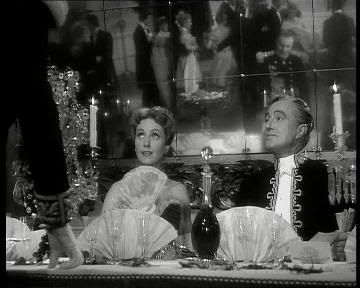 Valid discussions of Ophuls’s career are of course impossible if one bypasses the role of women in his work. The director’s feminist credentials can well be debated (are women not merely the most accessible and arguably effective tools with which to examine the more pertinent matter of love and its relationship to the social order?), but his consistent alignment with female characters cannot. 1934's La Signora di tutti receives numerous citations as the film where the mobile, Ophulsian camera of the 1950s first rears its head. Yet it remains equally significant for the development of its female-driven narrative, whose deconstruction of celebrity provides early prep work for 1955's more renowned Lola Montès. Signora's muddled interspersion of gaiety and tragedy struggles to locate the harmonious equilibrium of later films, but the presence of the ultimately sympathetic female protagonist is crucial. In so many of Ophuls's narratives conflict emanates from a woman's heart, and Signora illustrates this at its earliest stage. Feminine desire is forever engaged in a battle against the social order, and the dramatic friction caused by two such powerful, vital forces spills over into the everyday - a woman's revolt against society becomes an urgent struggle against other individuals and the self. By 1953, Ophuls excels in the transmission of such concerns, and thus the fractured characterizations and overt sensationalism that undermine Signora's tragic undercurrents are replaced with the intricately-drawn participants of Madame de...'s ill-fated love triangle, here supplemented by a melodramatic framework that magnifies the tragedy by unearthing its nuances instead of encouraging its histrionics.
One can also find a unique sense of bliss in the director’s image-conjuring prowess. Madame de...'s entrancing presentation of the Parisian Belle Époque is emblematic of his later films' expertise in realizing success on a base, though nonetheless intoxicating plane where luxurious artifice equates to unabashed viewing pleasure. And yet for many casual observers, Ophuls's visual flair either belies the integrity of his sentimental scenarios, or predicates a taste for surface sheen over narrative substance. To side with such charges however, is to ignore the acumen with which the director executes his magisterial vision. In Madame de... every track, every pan, every prop and every ray of light contribute to a suave exercise in cinematic deception. To borrow a prominent example, the trademark fluidity of Ophuls's camerawork embodies an interfilmic binary opposition through its ability to impart both liberation (acting as a spiritual extension that provides temporary release from the corporeal), as well as incarceration (by defining the parameters of this escape), all the while veiling its intents behind a shroud of dignified hyperactivity. A camera that is as happy to waltz with its subjects as it is to magically glide through walls understandably poses a threat to a hardened aesthete's resistance - but the illusory experience on offer in Madame de... is just that: a mask that disguises the camera's active participation in content as well as style.
 Concealed depths such as these are not just restricted to traditionally stylistic devices. A series of ironies and evasions perfuse the dialogue also, thus revealing the chasm between the characters' self-constructed exteriors and the realities of their internal yearning. Throughout their courtship, Louise insists to Donati: "I do not love you"; although neither lover nor audience believes this proclamation for a second, with the conspicuous lie betraying an antithetical truth. One of the heated encounters during the film's final act finds the General falsely accusing Donati of calling "the army, and consequently its generals... useless!" Donati says no such thing, but admits to the crime as a penance for his forbidden love - a topic that cannot enter the forum of public debate. And early on in the film, Louise and the General participate in a delicious tête à tête regarding the earrings' whereabouts. Their shared rapport is attractively transparent during verbal exchanges where the audience is privileged with the knowledge that both parties are deliberately suppressing their awareness of the truth to win greater gain from their significant other. Yet even in a comedic encounter that radiates as much warmth as this, narrative and visual style work in unison to intensify the film’s emotional canvas. Despite reinforcing the pair’s companionship with a sequence of shot/reverse-shots in close-up from their respective beds, the director employs an 180˚ pan to precede the sequence and two long-shots to conclude it, both sharing the same purpose: to divulge the startling distance between the sleeping quarters in question. Charm, vivacity and mutual affection may characterize the tone of this scene, but Ophuls typically ensures that it is a somewhat dispiriting lack of romance which the viewer is ultimately left to ponder.
Tellingly, marital vows in Madame de… are not far removed from those in other Ophuls pictures. Liebelei, La Ronde and Le Plaisir all to some degree depict the carefree attitudes with which certain partners treat their prescriptions of monogamy. Madame de…’s thorough exploration of frivolity’s limitations - which eventually unravel its characters’ pretences - allows it to differentiate itself from its predecessors with a triumph of depth. Late into the film, the General provides a remarkably bold and self-reflexive analysis of his predicament to Louise: “Our marriage is a reflection of ourselves. It seems superficial only superficially.” Both character and director effectively dare the viewer to better scrutinize story and frame, as the General’s startling recognition of his façade points towards intelligence undervalued. Moreover, the self-confessed undertones of role-playing allow us to presume that any shortfall in the romantic stakes has less to do with the couple themselves and more to do with the privileged positions that they enjoy within their social hierarchy. Their marriage may be a reflection of themselves, but they in turn are a reflection of society - at least, superficially.
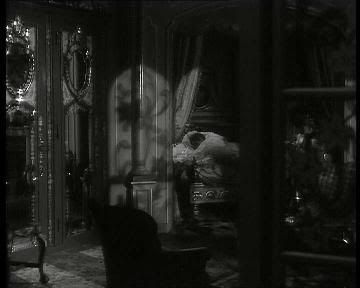
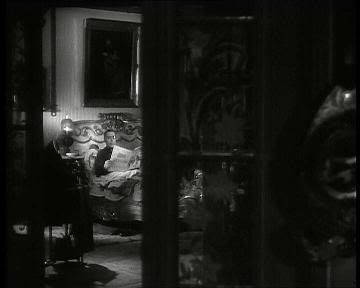 To elucidate the weight of the social obligations placed upon the haute monde, Ophuls frequently returns to scenes that involve communal gatherings. Lavish balls and operas prove indicative of the trivialities that plague a patrician’s schedule, whilst more serious-minded endeavors such as diplomatic meetings or hunts and duels function primarily as platforms for destruction. The seemingly irreconcilable subjects of fun and death hereby converge to define the director’s near-decadent portrait of elite social structures. True romance’s inability to persevere in such a habitat should therefore come as little surprise. Although its members are readily capable of emotional gravity, Ophuls’s high society is built upon a foundation of hollow joviality that constrains the emergence of feelings as potent as that of love. Hence, its textual absence until the arrival of a relative outsider thirty minutes into the film.
If the suppression of love is an issue for the aristocracy, then it is a problem amplified in the case of its women. With its suggestive title and its creator’s experience, Madame de… flourishes in the arena of gender politics, and a true to form Ophuls commits himself to imbuing the film’s every frame with an underlying commentary on the veiled sexism of the era. His aims are complemented by a narrative that parallels Louise’s extramarital impulses with that of the General’s, before investigating the ensuing hypocrisy that the contrast generates. Whilst society sanctions the husband’s apparent right to pursue sexual relations with another partner (his mistress, Lola), it simultaneously curbs the desire of the wife, whose genuine love for Donati is denied the opportunity for consummation. This basic inconsistency is key to Madame de…’s development, for the early revelation of the General’s adultery casts a permanent shadow over Louise and Donati’s romance, acting as a perpetual reminder of the inequality inherent within the marital couple’s partnership.
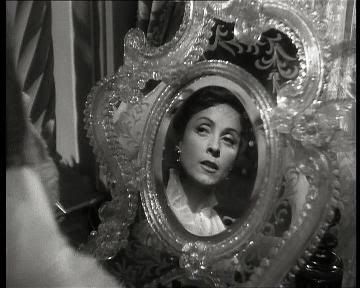
 Ophuls’s opulent mise-en-scène is never more alive than when expanding upon this theme. From the outset, the director instigates a dynamic cinematic correspondence with the viewer that deepens his plot with coded imagery. The lauded opening take of the film lasts for approximately two and a half minutes, and as Louise briskly mulls over her possessions (her debt as yet unknown to us), the camera effortlessly skims around the room with her. In a tantalizing move, Ophuls refuses us an unobstructed view of his heroine for over half of this take, instead opting to interrogate her ornate surroundings - dominated by innumerable jewels, furs and mirrors. When the mystery of Louise’s face is finally revealed to us, she appears not in front of the camera, but as a reflection in one of these dressing-table mirrors. Thus, she is promptly divulged as another constituent in the commodity-infested environment on-screen. Although Louise’s gaze stares back at the audience, her physical presence as the film’s subject is overwhelmed by the multitude of surrounding props, motivating her retreat into objectification. Our perception of the aforementioned commodities thereby undergoes a significant transition: no longer are they mere symbols of wealth and power, they now morph into instruments of covert patriarchal oppression - symptomatic of a “trophy wife” culture that’s adhered to all too fervently. In hindsight then, it is uncomfortably incongruous of Louise to state that “…I can do as I like with them,” when discussing her valuables this early on. Her chimera of independence is negated by the exact materials that furnish her fantasy.
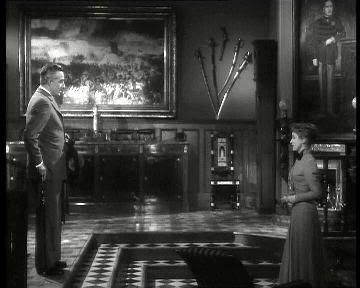
As if to thwart any lingering doubts that the viewer might have about Ophuls’s thematics, the scenes that immediately follow his bravura introduction conspire to consolidate Louise’s commodification. Over breakfast, she is confronted by a looming portrait of the General that establishes his authority as the archetypal patriarch, not to mention her diminutive figure in relation to the social order, over five minutes before he makes his first physical appearance in the film. After leaving her home Louise visits a church, in which she visibly arouses the interest of a praying soldier, before reaching her intended destination at a jeweller’s (Monsieur Rémy’s), where she again causes titillation as both the tradesman and his son struggle to contain their own desires. At each of these stages Louise is able to either ignore or spurn the attention showered upon her, but never is she able to entirely reject her elemental status as a receptacle of the male gaze.
 Curiously, for a notable portion of the film Louise actively revels in this socially-sanctioned role. During the film’s first act she cheerily absorbs male affection and cultivates a reputation as a sort of sophisticated coquette. It is a position that her husband both observes - “she is adept at making you die of hope” - and accepts: “A pretty wife is meant to be looked at.” In a context where gender equality is palpably absent, Louise’s simple concessions to her voyeurs enable her to manipulate the prevailing male attitudes of chivalry and lust to a limited extent, thereby granting her a minor but nonetheless important degree of control within her social circle. In spite of this victory, the budding relationship with Donati later in the film provokes Louise to relinquish her privileges in favour of an all-consuming romance: “I hate society. I want no one to look at me but you.” In actuality, the concept of self-objectification is so ingrained into her mindset that her defiance is rendered a delusion. Louise may attempt to reject collective demands, but by immersing herself so wholly into an individual’s gaze she finds herself entrapped within a different social norm bound by the same stipulation: an existence that is to be defined by her male admirer(s).
Louise is thus incapable of negotiating herself a status greater than that afforded to the possessions that she so cherishes. In essence, she remains another thread in the materialistic drape that blinds the nobility. It is therefore ironic that her life should come to depend so heavily upon the earrings referenced in the film’s (unfortunate) American title. If Louise is exemplary of the patriarchy’s propensity for objectifying its subjects, then the earrings conversely relay its ability to substantiate its objects. Their initial worth is minimal: relics of a marriage contract that each partner treats with merry nonchalance. When Donati miraculously returns them to Louise however, they assume the romantic significance that should arguably have always been assigned to them. It is the discord in personal value between the General’s original gift and Donati’s emotionally-repackaged version of it that triggers the former’s determination to remove them from Louise’s grasp, escalating their price towards even loftier heights. By the finale, they are so value-laden that they undergo a metamorphosis from recreational commodities to religious exhibits. In other words: they become priceless.
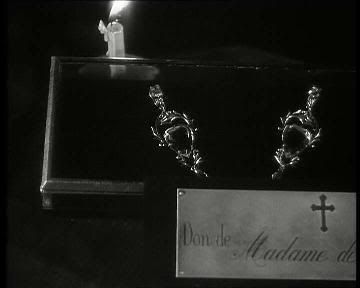 Although the narrative suggests that Louise’s original transaction occurs due to her debts (as well as an implicit need to protect her husband’s prestige), the film’s peculiarly nameless title and the cause-and-effect frameworks that link the earrings to Donati (and therefore, love) hint towards alternative reasoning: a subconscious longing on Louise’s part to escape the confines of her marriage. Standing against her is a patriarchal clasp on Madame de…’s theatre of exchange that is especially rigid, as demonstrated most clearly by Monsieur Rémy’s consultations with the General. The jeweller’s betrayals of Louise’s misplaced confidence stifle her inadvertent rebellion, administering her passivity in an economic sphere that restricts marketplace activity to men. Meanwhile, Rémy’s visitations to the General’s barracks additionally help to establish a visual association between the military and the return of the earrings, binding the latter to an ultra-masculine order that repeatedly lures them back from their misadventures. It is only her husband’s refusal to re-purchase the jewellery at a critical juncture that allows their escape from this system, meaning that Louise’s triumph over the rules of trade is a virtually empty one. Furthermore, she exchanges almost all of her valuables to regain the earrings, an act that violates the social codes that her possessions represent. By disregarding la règle du jeu, Louise sets into motion the chain of events that will drive both her and Donati to their ruin. This is the cost of forbidden love in Ophuls’s world.
A specific distaste for patriarchal regulations permeates much of the director’s work, and with the evidence thus far one could certainly argue that the trait is most pronounced in Madame de…. Fortunately, Ophuls is sagacious enough to prevent his art from descending into misandry. The film may condemn the status quo, but it sympathizes with everyone that it subjugates. Ophuls counterbalances Louise’s woes with the subsequent repression of the men around her, observing that both the General and Donati are suffocated by the very system that endows them with their primacy. That the latter should meet his end thanks to a duel with the former only compounds this issue. Throughout his career the director casts a critical eye upon this socially-acceptable contest of “honour”, though he lambasts the doctrines that permit it rather than the individuals that perform it. This conflict’s victim is perhaps the least interesting member of the film’s romantic triumvirate, but he is also its most important catalyst. It is Donati’s arrival that propels Madame de… to its giddy highs and its cataclysmic lows, and with his loss both Louise (whose fate becomes entwined with his own) and the film helplessly expire. If his need to look up “desire” in a dictionary and his willingness to terminate relations with the heroine invites the viewer’s suspicions, then his resigned fatalism during the final confrontation scenes emphatically dispels such doubts. When Louise questions him - “You do no longer love me…?” - Donati’s failure to respond implies that his decision to fight is a harrowingly necessary one: death is now more preferable than the burden of a broken heart.
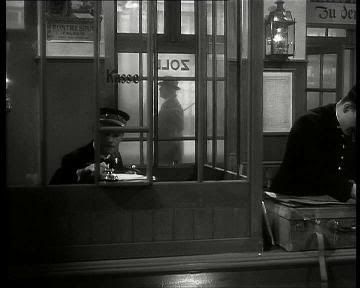
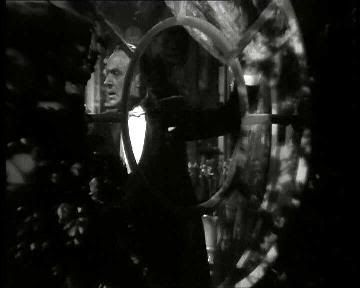 Donati’s murder/suicide further tarnishes the filmic standing of the General, whose effective implementation of social protocols means that of the film’s leads, it is he who veers closest to reprehensibility. However, looks always deceive in an Ophuls picture, and the General is relieved of potential villainy by the director’s careful assertions of his vulnerability. Whilst his breakfast-room portrait that was noted earlier does indeed have a foreboding presence, it is the disparity between role and reality that strikes a chord with the viewer: the charming, urbane and surprisingly short man married to Louise is a far cry from the tall, imposing and authoritative figurehead of the painting. In a much later scene where the General attempts (and fails) to exert this authority by dissuading Louise from leaving Paris, he restlessly begins to shut all the windows in his house. Borrowing a technique from Le Plaisir, Ophuls shifts perspective by cutting to an external tracking shot to document this action. The camera’s placement outside the zone of activity allows it to assume the gaze of an extraneous influence at the precise moment when the General locks himself and Louise inside their home. Had the camera been placed behind him, one could have asserted that the General was in control of this decision to entrap; but by venturing beyond the initial line of vision, Ophuls implicates society for the filmic snare and indicates that this patriarch is as fundamentally enslaved by its conventions as his wife. As he himself poignantly conceded earlier in the film: “We are not our own masters… especially a general.”
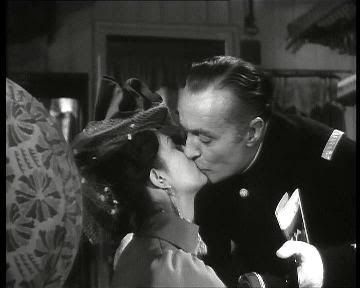
This revelatory statement is spoken during the departure scene of his mistress, Lola, and is echoed later on by a near-identical episode with Louise. A comparison of the two incidents unearths the depth of the General’s feeling for his wife. His overall demeanor with Lola is a continuation of the playful ebullience with which he is initially synonymous: he seduces, bids his farewells and exits without once looking back. By contrast, Louise’s departure induces his first visible signs of melancholia, and as her train leaves he gazes forlornly at the mechanisms that pull his wife away from him. In another of the film’s many ironies, it is Lola who receives the farewell kiss on the lips, with Louise settling for an unnervingly formal peck on the hand. The General’s superficial lifestyle and his adherence to militaristic codes have paralyzed his confidence in genuine matters of the heart. Of all the characters in the film, it is he who suffers the greatest divergence between their public and personal identities.
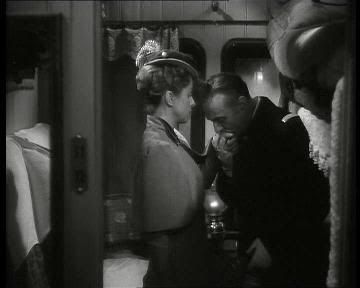 Madame de…’s great tragedy then, is that all of its leads experience an epiphany during the course of the film. Take Ophuls’s euphorically informative visuals out of the equation and they begin, on paper at least, as shallow and careless individuals, content to wallow endlessly in their merry masquerades. As their character trajectories progress however, each of them undergoes a radical change. The introduction of passion into the narrative engenders a process of humanization that coincides with an increasing awareness of their desires. Unfortunately for them, these desires also unravel their orderly lives, heightening the need to restore the frivolous standard and imprisoning them within roles that they no longer wish to play. And with the comings and goings of the earrings constantly sculpting the film’s emotional panorama, one begins to comprehend just how irrevocable society’s materialism really is.
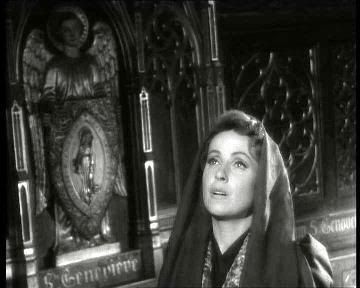
Materialist ethics go so far as to infiltrate the domain of the spiritual. “My cross?”, says Louise in the opening scene when evaluating her possessions, “Oh no, I adore it!” Her actions in the film affiliate religion with the prevalent world of transactions, but neither she nor Ophuls ever lose sight of its intensely personal value. Towards the end of the film, Louise visits a church and begs a saint to accept her treasured earrings as a suitable exchange for Donati’s safety. The saint’s apparent “refusal” to enter into this bargain says less about the absence of the divine than it does about the worth of life itself. Ophuls uses Louise’s act of desperation to delineate between the institution of the Church and the integrity of private faith: it is the former that accepts the gift and presents them in their most fetishized form at film’s end; it is the latter that reassigns the ethereal relevance entrusted to the earrings unto Donati’s existence. The celestial powers-that-be thus reveal themselves as the only abstract forces in the film that esteem the invaluable beauty of the human spirit over the metallic perfection of the earrings. In freeing Donati and consequently Louise from the shackles of society, it could be argued that the saint does, in actuality, grant her wish. The film’s seemingly tragic finale allows the couple to relocate their love to the only realm in which it can possibly survive: the afterlife.
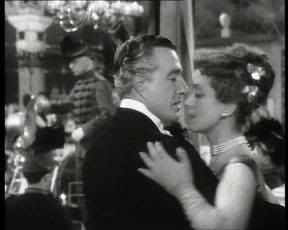
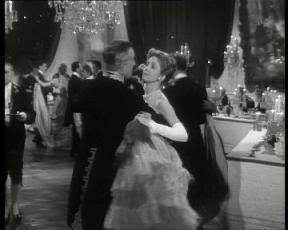
 There is a sequence in Madame de… whose reputation is nearly as great as the film’s own. It can be summarized as a dance between Donati and Louise, but to describe it as such seems a woeful miscarriage of justice. It is more akin to an elegant roundelay of passion, charged with all the urgency of repressed desire. As the two admirers waltz, the director’s camera seamlessly cuts and dissolves around them, layering emotional subtexts onto one another and completely disregarding time whilst remaining all too aware of the threat that it poses. The cumulative effect of all this is overwhelming, compelling the audience to surrender themselves to the impeccably crafted-insularity of the burgeoning love that saturates the frame.
It is this enchanting sequence that best encapsulates the spirit of Ophuls’s magnificent art. Supported by his camera’s graceful choreography, the director concisely articulates the importance of pure sentiment in environments where they are consistently marginalized. Moreover, he excels in charting the progression of such feelings: during a five-minute ballroom routine Ophuls can leap at will from formality to informality, from vacuity to cognizance, and most importantly from frivolity to love. For this artist, such oppositions work in symbiosis to enrich the texture of his films, and his penultimate effort exemplifies these contradictions at their finest. It enamours with its celebration of the superficial, only to take apart its own convivial artifice once the viewer is on side. When its masquerade is eventually unclothed, there lies a film that exalts love as the greatest emotion that one could ever know. In denying this joy to the characters with whom it is so acutely attuned, Madame de… proves itself to be the most cynical of all cinema’s great romances.
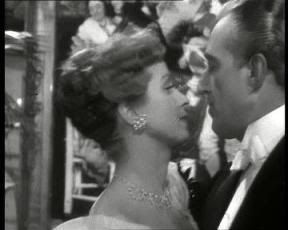
The Round-Up (Jancsó, 1965)
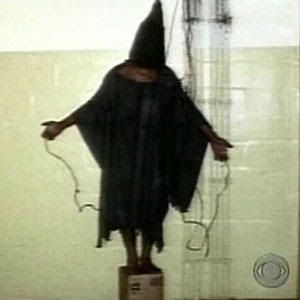 Welcome to The Round-Up.
This is a world of desolation. This is a world of containment and oppression. This is a world where physical and psychological torture are considered routine; where men commit suicide simply to escape the nightmare that is reality. Honestly, this is not a world at all: this is madness.
A detention camp provides the immediate setting of Miklos Jancsó's macabre experiment. It is the resounding sparseness of this prison that proves so unnerving. Tall, whitewashed walls and a series of compact sleeping cubicles are the only notable features in what is otherwise nothing more than a large empty space. The surrounding Hungarian plains that engulf this complex offer little solace - they seem to breed malevolence within every blade of grass. Jancsó has a particular interest in exploring psychology's potential for shaping space, and as the absence of humanity begins to unsettle the viewer, so the barren expanses become inversed to induce a stifling sense of claustrophobia.
Minimalistic rigour characterizes Jancsó's visual style. He favours long, observational takes that leisurely pan around his characters, encircling them further within their confines. Moreover, he deploys a number of crane shots to open up his widescreen format to its greatest capacity. Always, there is a detachment of camera from scenario that allows Jancsó to toy with characters as if they were miniature figurines. Indeed, this is exactly what they devolve into when the director is at full visual flight. There are times when the film unfolds as if in a militaristic ballet: humans move in and around the frame with geometrical precision, exposing a vital discord between the systematic modernism of Jancsó's framing and the harrowing primitivism of his narrative content.
The Round-Up deals with plot on only the very loosest of terms. There are army officials and there are prisoners. The former wish to identify a group of rebels amidst the latter, much larger group, and repress accordingly. Although physical might is wielded (as we witness on more than one occasion), the preferred method of persecution here is more covert. Ruthless verbal interrogations instigate a series of double-bluffs and betrayals amongst the defenceless detainees, fuelling an atmosphere of distrust. Most terrifying of all however, are the long stretches of film when the authorities do absolutely nothing. Jancsó's limited use of dialogue and the frequent absence of significant activity means that silences can overwhelm the compound, throwing its characters and audience into the uncomfortable territory of the unknown. Factor in the stifling emptiness of the aforementioned surroundings, and one finds oneself in a situation where the overarching intent is to numb the mental state, making it ripe for degradative manipulation.
This is a film that quietly consumes its audience, as opposed to vice-versa. After a short but wry prologue, it places us in a situation where we are as lost and disorientated as the prisoners on-screen. Jancsó's camera is far too impassive to examine any of the characters in real detail, and the refusal to question their behaviour effectively presents dehumanization as a fact of life. Additionally, this impassivity restricts the emergence of an identifiable protagonist - [Spoiler]the closest we get is with János, who is murdered well before the final act[/Spoiler]. The emotional substance that we so often demand from the cinema is on permanent vacation here, and in denying the potential sentimentalization of his prisoners' plights, the director confronts his audience with an unappealing proposition: to fill in that resonance themselves. Jancsó dares us to turn a blind eye, whilst holding up a mirror to our conscience.
Roughly fifty minutes into the film, there is a brief moment where it seems as if the prison might degenerate into mass chaos. Tellingly, these few seconds of violent commotion gift the viewer with a reprieve from the cold, military order that swiftly overwhelms the rebellion. It also spares us, however fleetingly, from our increasing awareness of the military's formidable grasp on the mechanisms of power, for it is this realization that unmasks the real horror story of The Round-Up. This is a film that was made over forty years ago, and it’s set almost another hundred years before that, but it never feels anything less than unerringly prescient. Jancsó's observations regarding the abuse of power eclipse time and retain contemporary significance. Do today's conditions of cruelty deviate notably from what is shown in the film? The director suggests that moral absence is an everlasting theme of history, and one finds it hard to resist his arguments. This may be madness, but this is above all a world that we recognize and shape – this is the tragedy of the human condition.
So yeah, welcome to The Round-Up. Did I mention that escape is futile?
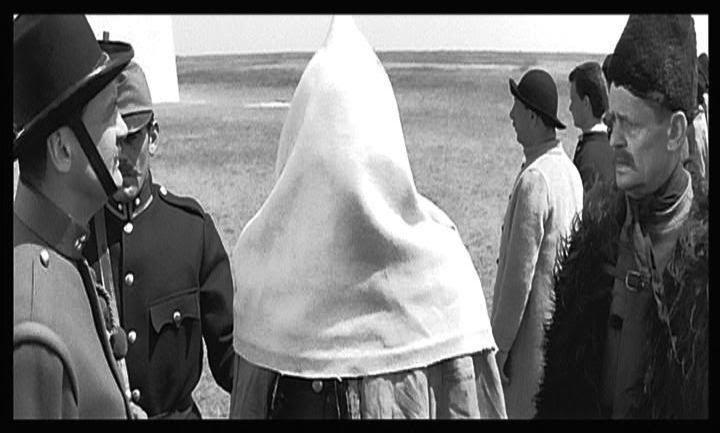
Ivan's Childhood (Tarkovsky, 1962)
 Anti-war films have traditionally struggled to traverse the narrative minefields generated by their thematic concerns. The nature of their idealism makes it difficult to navigate around material that can so easily lapse into a tedious sermon of maudlin sentiments, misguided politics and/or manipulative moralizing. These pitfalls tend to be best avoided by more original treatments, and Andrei Tarkovsky - a director who so frequently dispensed with traditional conceptions of narrative - would seem an ideal candidate for such a task. His stature as one of cinema's master craftsmen is not unfounded: an ability to encapsulate the depth of the human spirit within sensory feasts of fragmented time, ambiguous sounds and incomparable visual poetry endows him with a genuine claim to the "greatest of all time" moniker. If anyone can tackle the dangers of this emotional-ethical fabric and come out unscathed, it is surely this man.
Understandably, one turns to Ivan's Childhood with high expectations. This is, however, Tarkovsky’s debut feature - and it shows. The director has never flirted so closely with standard narrative etiquette; the "sculpting in time" aesthetic present in only its most primordial form thanks to a number of flashback/fantasy sequences. Although the film is named after him, the scrawny-yet-aggressive Ivan's thirst for vengeance surrenders screentime to both Galtsev (an idealistic and inexperienced lieutenant) and the momentum-sapping Masha (a vapid teenage nurse). The young Tarkovsky ambitiously attempts to paint a multifaceted portrait of wartime frailty, but the resulting fragmentation is swamped by the intensity of Ivan's subjective memorializations, hindering the broadness of his scope.
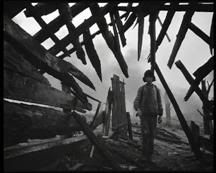
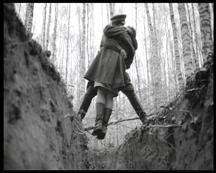
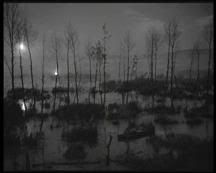
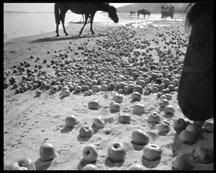 These reveries also display a worrying penchant for simplifying the complexity of war into the black of the terrifying present, and the white of the remembered past. Such bold delineations are uncharacteristic of Tarkovsky, who would spend the remainder of his career inhabiting much grayer textual areas. Nevertheless, they succeed in externalizing the internal conflicts of a troubled youth, whilst providing the director sufficient space to experiment with his imagery. And what imagery that is! Tarkovsky’s visual genius is apparent in even the earliest of his features, where he plays with the idea of stylistic dualism: the naïve lyricism of Ivan’s memories is set against the expressionistic horrors of the war, and piercing gunshots mark the tenuous borderline between the two. The ensuing antagonism triggers the film’s evolution into a mesmerizing cornucopia of wild kineticism and delirious angles that fight for supremacy over the sensual tranquility offered by the natural world and its maternal comforts - the quieter half of this duality anticipating the director’s later cinematic elegies with its deconstruction of the “Mother Nature” image.
Ivan’s Childhood provides a rare opportunity to witness a great artist threatening to stumble, as Tarkovsky very nearly does at the last hurdle with his problematic decision to intersperse newsreel footage into the text (these images of reality being outweighed in substance by the director's fiction, thereby undermining the integrity of his moral stance). But alas, he recovers, and the film regains its composure with a final sequence that stands as one of the great tributes to innocence lost. The very best anti-war films are those that can communicate their resonance without preaching it. With its poignant conclusion, Ivan's Childhood creates a tragic delusion that tells us everything that we could possibly wish to know about the grave, destructive costs of war by saying nothing direct about the subject in question. By refraining from the obvious, Tarkovsky transcends all genre constraints and lays the foundations for a future that would prove itself to be unrivalled.
Dead Ringers (Cronenberg, 1988)
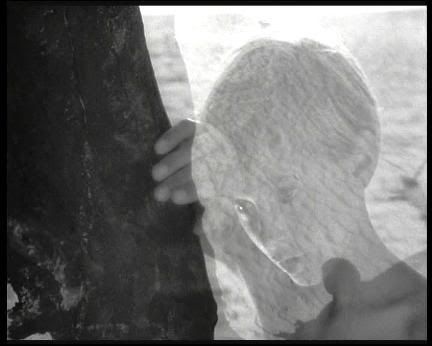
 Dead Ringers (1988) marks my fifth David Cronenberg experience - and with this provocative, fascinating film he solidifies his status as one of my favourite English-language directors of recent years. I appreciate how beneficial this viewing proved for my understanding of his filmography - only now have I grasped just how intensely psychological Cronenberg's work is. His films seem to be terrorized by the inner demons of his characters, and the themes of sex, technology and violence that he so favours assume a more emotionally potent dimension as a result.
In this particular film, Cronenberg chooses to personify the concepts of yin and yang with a pair of identical twins. Their intense fraternal bond reaches far beyond the platonic - when Beverly (the yin to his brother Eliot's yang, at least initially) angrily cries out: "Do you think I'm gay or something?" after the most minor of provocations, he alludes towards deeply repressed homosexual tendencies that manifest themselves most clearly with the perverse sexual co-dependency that he shares with his brother. By casually exchanging one another's women, the Mantle twins find a successful outlet for their mutual desires. Their professional status (as gynaecologists) intertwines with their subconsciousness: the objectivity with which they examine the vagina during the everyday allows them to eschew the remnants of their heterosexual attraction to it. The female genitalia's socially-sanctioned purpose is therefore displaced as the brothers reclassify it to the role of an illicit harbour for their most intimate physical connection. The Mantle twins don't fuck women at all, they simply use them to fuck each other.
When the sensual and ever-astute Claire begins to figure out their ruse, the brothers' tenuous harmony is understandably thrown into chaos. Her confrontations trigger a psychosexual rupture within Beverly's fragile state of mind, leading to an attempted fission of the unique Mantle union - which in turn provokes Elliot's own slide into mental disarray. Finally, the pair are forced to confront their sexual fears and urges - and, with Cronenberg's brilliantly grotesque visualizations in tow, so too is the audience. Beverly may be externally devoted to her, but he subconsciously continues to view Claire as an object or, more specifically, a "mutant". A lifetime of ignorance regarding their misuse has birthed a vagina that fights back with reason. Ironically, the doctors cannot reciprocate the intellectual war, and respond only with the undercurrents of violence that have lurked ominously since the film's opening credits. "The women's bodies are all wrong!", says Beverly, as he wields the newly-distorted blades and instruments that constitute his new arsenal for gynaecological warfare. In misplacing the blame for his predicament he merely ignores his own figurative mutations, and thus entrenches himself further within the claustrophobic psychosexuality that will destroy the Mantle entity.
Sex has always been the most intriguing vertebra in the backbone of Cronenberg's oeuvre. The director's films consistently deconstruct and then reconstruct the concepts of sexuality and desire. Dead Ringers continues in this vain, as it reconceptualizes our perceptions of bondage gear to include an absolutely bizarre (but incredibly hot) amalgam of medical tubes and scissors. And how easy is it to dismiss the inherently sexual instruments of "gynaecological warfare" cited in the previous paragraph? Their sharp, steely disfigurements endow them with the means to horrify, but the camera's decision to fetishize the objects draws attention to their penetrative potential. Sex and violence share an uneasy yet scintillating co-existence in Cronenberg's world of malevolent perversity where human survival exists in perpetual limbo.
Cronenberg films his subjects with clinical precision to conserve this sense of unease: cool, icy whites and blues dominate the colour palette, rendering the eventual bursts of red frighteningly inevitable. Yet in spite of this cold treatment, one never feels that he has anything less than the utmost sympathy for the damaged souls at the heart of his film. Dead Ringers may not be its director's finest effort (from what I've seen, Crash takes that title), and it may not even be the best 1980s flick about disturbed male twins (an honour that must surely be afforded to Peter Greenaway's visually resplendent diatribe against Thatcherite Britain, A Zed & Two Noughts), but this is nevertheless a work of surprisingly moving beauty. I'm finding that Cronenberg's most interesting films deal with a sort of reverse spritiualism, whereby scientific and technological forces are engaged in an everlasting battle to denigrate the human spirit. Sure, there's blood, there's gore and there's a helluva lotta sex, but the director's indulgences are the inevitable results of his explosive examinations. In their own way, films like Dead Ringers and Crash strike me as cinematic hymns for the lost souls of postmodern society - and that surely makes David Cronenberg one of the most justifiably humane directors working in the medium today?
Ballad of a Soldier (Chukhrai, 1959)
 Ballad of a Soldier comes armed with a hefty reputation as one of cinema's great war movies. 8.2 on IMDb? Resounding raves with every review that one reads? A quick Google search should uncover words like "lyrical", "poignant", "understated", "poetic" and "humane". Criterion go so far as to describe it as "unconventional"!
Bullshit.
The appeal of Chukhrai's "masterpiece" will lie solely with good-natured numbskulls who struggle to resist the simplistic trite that the director offers up for them. Ballad is a film that chooses to disregard the horrors of war in favour of a tentative romance between an ennobled young hero and a flawless young heroine. This is all very well and good (who are we to assume that such love stories cannot exist in times of turmoil?), and Chukhrai reveals wise judgment in situating a sizeable portion of his film within the enclosed space of a hay-filled train carriage, thereby extinguishing the necessity to comment on the external world. But Chukhrai cannot hide forever, and it is when finally obliged to leave his safety pen that he misfires so horribly. An early battle (the film's only one) prepares us for what is to follow: edited as if to resemble a chase sequece in a commercial monster movie, it typifies Chukhrai's audience-pandering aesthetics that cheapen the integrity of the war effort. As if this wasn't enough, the film's peculiar conception of Soviet life in this era is defined by the military's jovial camraderie and the everyman's ceaseless charitability. This presentation of World War II as a positive catalyst for community spirit and patriotic idealism smacks of propagandistic conceit, but its most bitter aftertaste is one of emotional manipulation. When destruction finally, inevitably enters the narrative, Chukhrai's blissful portrait is exposed as a detestable setup designed solely to extract greater dramatic weight for the viewer.
Late into the film, the protagonist (Alyosha) finally reunites with his beloved mother (lest we forget that Ballad is a vigorous proponent of traditional family values). Their tender embrace is perhaps the film's only genuinely poignant moment, but even here understated silence quickly regresses into melodramatic wailing. Thus, with partial redemption on offer the director insists upon maintaining the saccharine, insulting the intelligence of all innocent civilians unfortunate enough to experience his contemptible dirge in the process. For the 23 million Soviet citizens who lost their lives in the Great Patriotic War, Chukhrai and his superiors could not have crafted a better cinematic fuck you.
Well, fuck you too, Grigori Chukhrai. Tosser.
Thursday, 29 May 2008
Distant Voices, Still Lives (Davies, 1988)
 Terence Davies's intimate investigation into the persistence of memory announces its intents with its opening sequence. A BBC shipping forecast is heard off-screen as his camera statically observes the exterior of a somewhat dreary house. In the middle of a storm, a woman (known simply as "Mother") opens the front door and collects the bottles of milk that have been deposited outside. She quickly returns to the safety of her home, and Davies follows her by cutting to a shot inside the house. The camera remains static as we now observe the unsurprisingly drab interiors of this humble abode. Mother shouts up a staircase to awaken the other members of this household. After a second reminder, we hear the rest of the family coming downstairs - but curiously we do not see them, although off-screen dialogue identifies them as Mother's children. As "I Get the Blues When It's Raining" plays on the soundtrack, the camera slowly glides forward towards the staircase before completing a 180-degree pan and resting upon a shot of the same front door that we had previously viewed externally. The shot dissolves and a temporal ellipsis occurs - the formerly closed door is now wide open, revealing a hearse pulling up outside (the storm has since disappeared). Another dissolve leads to a tableaux of Mother and her three children (Eileen, Tony and Maisie) staring directly at the camera, as if from a photograph album. The soundtrack has since moved on to an operatic rendition of "There's A Man Going 'Round Taking Names". The camera once again glides forward, this time towards a genuine photograph hanging on the wall. As the family walk off-screen, the image of a man and his horse comes to dominate the frame. In its lucidity, we correctly presume that the man is the (now deceased) "Father" of this household.
In under four minutes then, Davies manages to fully establish the context in which Distant Voices, Still Lives will unfold. The shipping forecast and the decor situate the film historically in the post-war era of late 1940s/early 1950s Britain, and the latter also helps define the distinctly working-class milieu that the director will survey. Familial bonds are already placed at the fore, and the early allusions to weddings (during the words that Mother and Eileen exchange off-screen) and funerals emphasizes the communal rituals around which the film's loose structure is constructed. The long-takes, gentle pans, tableaux vivants, frequent dissolves and stately pacing that characterize the film's visual style create a stream of consciousness sensation that intensifies and complements its narrative of remembrance. Meanwhile, Davies's veritable soundscapes marry the everyday rhythms of blue collar life to a catalogue of incredibly emotive songs, whilst further muddying the waters of time: the traditional relationship of aural to visual is modified to accommodate the temporal ellipses that pervade the film. In the director's complex memorializations, the manes of the past engage in an neverending process of imprinting themselves upon the present. The close-up that concludes the opening sequence identifies Father as this film's ghost that refuses to disappear.
Distant Voices, Still Lives is actually a diptych of two short films that comprise a single 80-minute feature. Although structured as a serene entanglement of memories, the differentiation is not inappropriate as the first part (Distant Voices) clearly focuses on life with Father whilst the second (Still Lives) is concerned with life after him. The coercion generated by the presence of this antagonistic patriarch renders the Distant Voices segment the more emotionally volatile of the two, with its tones oscillating wildly between the harmony of recollection and the trauma of unhealed wounds. Numerous juxtapositions enunciate these cinematic mood swings: one such instance finds Eileen longing for her father's presence, but the scene that immediately follows finds said Father savagely beating his daughter with a broom; in the midst of her piercing screams, Davies cuts back to a shot of Eileen summoning a brave smile and repeating her initial refrain - "I wish me dad was 'ere". Tragic irony is used to expose Eileen's blind reverence as a symptomatic consequence of domestic violence, and the device will feature frequently in both halves of the film.
 Despite its tendency to appeal to our sympathies, one shouldn't fall into the trap of making character judgments as a result of a single (albeit fairly typical) sequence. A later juxtaposition finds Father placing stockings on his children's bed at Christmas, and in this rare moment of clarity the paternal affection that radiates from his unassuming face is endearingly visible. Naturally, the very next scene sees him exploding in untriggered fury at the dinner table, before ordering Mother to clean up the damage caused by his wrath. The contrast here is especially vital, for not only does the film's prevalent streak of character ambiguities finally manifest itself in the most unexpected of locations, but the completely unprovoked nature of the outburst implicates external factors beyond their control for both Father's authoritarianism and his family's capitulation to it. One senses that these troubles are not entirely divorced from their socio-historical context - the archetypes of the British working-class ingrain themselves into these characters, and a reluctant tolerance of domestic strife is the result.
Still Lives builds on this premise by quietly shifting the film's focus from the private to the public sphere, thus comprehensively articulating the social dimensions that tantalized in Distant Voices. It expands upon the collective practices of the family and views life itself through the prism of multiple social gatherings, thereby reinforcing their status as one of the core components of this class experience. The prominence of baptisms, weddings, funerals, Christmases, and even (or especially) meetups at the local pub highlights the reassuring unity that can be offered through these shared encounters, and it's a comfort that confers the women in particular with the strength to assert their once "distant" voices. These female and communal proclamations take the form of songs that are contemporaneous with the era, and which subsequently uncover the most intriguing peculiarity of Davies's work: its relation to the movie musical.
The use of songs as an extension of the characters' mindsets is a recurrent feature in Distant Voices, which fluctuates between the use of diegetic and non-diegetic sound. However, Still Lives finds a more emphatic movement towards the former option, and in doing so it transposes the essence of the musical into the unlikeliest of contexts. Its expertise in conveying the transformative power of personal expression is contrasted against the bleak actualities of impecunious Liverpool, thus exposing a painful dichotomy that denies its characters the multicoloured transcendence available to their Hollywood predecessors. When Eileen defiantly belts out a heartfelt rendition of "I Wanna Be Around" in solidarity with her best friend, the entire world momentarily seems to pause as a lifetime of suppressed sentiments comes to the fore. For less than a minute the cathartic bliss of movie-euphoria overwhelms both film and audience - but never are we divorced from reality. The grimy, indifferent pub setting and the presence of its misogynistic males drives the song towards its ecstatic highs, but it's these same factors that simultaneously provoke the sombre resignation on Eileen's face after her impassioned stand is completed. The long-term viability of this brand of escapism is something that Davies and his characters are all too acutely aware of.
 "I Wanna Be Around" is exemplary of the softened restrictions facing modes of expression in Still Lives. Father's absence here alludes to an elapse of time that provides it with a greater scope than its sister segment. Time inevitably causes change with progression as a potential byproduct, but the content of Still Lives is a fundamental actualization of its title. In spite of slight but discernable differences such as the increased presence of radios and the more affirmative female voices, this later section maintains the introspection of Distant Voices both stylistically and emotionally. One of Davies's deftest touches in this regard is the motif that he creates with doors - throughout both parts characters are framed against doorways, quietly magnifying their need for escape. Tellingly however, the doors are used as entrances as opposed to exits - and in the few instances when people do exit, it's simply to collect an item before returning back into the comfort of their home. The need for escape is a projection of the audience's desires onto characters who resist with the insularity that dominated their life with Father, thus accentuating the discrepancy between our freedom and their entrapment. In this way, Distant Voices feeds directly into Still Lives: the transitional scene between the two is punctuated by an off-screen male's angry screams at Eileen. Had it not been for the man's utterance of "I'm your husband!", we would have sufficient grounding to presume that this was another flashback with Father. And yet in some senses it is, for the cyclical nature of abuse has fully manifested itself within this family's lives, and the spirit of their patriarch continues to infringe upon the action from beyond the grave. The past's inextricable link with the present ensures that the ruins of the former will permanently handicap the latter.
This is not to say that Davies's film is a bleak one, however. There are glimpses of deliciously off-the-wall humour (think Uncle Ted), and its resonance derives from the autobiographical warmth of tender familial bonds that even Father can't destroy. Perhaps the most memorable sequence in the film occurs towards the end: a crane shot rises from a floor of umbrellas amidst pouring rain, towards the roof of a movie theatre as the swelling strings of "Love Is a Many Splendored-Thing" inundate the soundtrack; as we pass a poster for said film, the take dissolves into a delicate pan over the faces of the audience, before resting on Eileen and Maisie - weeping like little children. These two simple shots serve as a beautiful homage to the unparalleled power of cinema, and it's a description that's perfectly applicable to the rest of Distant Voices... Davies's working-class ballad is a staggering achievement that refuses the despondency that many of his compatriots succumb to when dealing with the underprivileged: under this director's microscope, their troubles are harrowing, but they themselves retain their dignity. Moreover, the fragmented narrative functions as a breathtakingly unique exposition of the internal, imbuing each of Davies's exquisite compositions with an emotional panorama that remains unmatched within British filmmaking. Through this series of disjointed memories, the director crafts a remarkably cohesive and full-bodied portrait of life itself, and whilst doing so pays tribute to: the cinema; the working-classes; the past; the present; and, most stirringly, the future. For any astute film enthusiast (and particularly those that are British), Distant Voices, Still Lives gives cause for pure elation.

Subscribe to:
Posts (Atom)